This AI agent identifies global disruptions and executes recovery plans in real time, reducing delays by 40%.
This AI agent identifies global disruptions and executes recovery plans in real time, reducing delays by 40%.
In 2025, global supply chain managers are facing a "Fragmentation Crisis," juggling over 10 different software systems to manage increasingly volatile routes. While traditional AI can predict disruptions, a "Decision Velocity Gap" remains, requiring humans to spend 6–12 hours manually coordinating fixes across departments.
In 2025, global supply chain managers are facing a "Fragmentation Crisis," juggling over 10 different software systems to manage increasingly volatile routes. While traditional AI can predict disruptions, a "Decision Velocity Gap" remains, requiring humans to spend 6–12 hours manually coordinating fixes across departments.
To understand the "Why Now," I analyzed industry reports from Gartner, McKinsey, and Deloitte. My findings highlighted a systemic shift in the logistics industry for 2025
To understand the "Why Now," I analyzed industry reports from Gartner, McKinsey, and Deloitte. My findings highlighted a systemic shift in the logistics industry for 2025
I conducted three deep-dive interviews with Logistics Leads to map their workflows and emotional triggers.
I conducted three deep-dive interviews with Logistics Leads to map their workflows and emotional triggers.
Global Logistics Managers : Who manage hundreds of active shipments and spend up to 6 hours a day on manual follow-ups
Global Logistics Managers : Who manage hundreds of active shipments and spend up to 6 hours a day on manual follow-ups
Secondary Stakeholders : Internal Sales, Finance, and Operations teams who require real-time updates on shipment delays and financial impacts
Secondary Stakeholders : Internal Sales, Finance, and Operations teams who require real-time updates on shipment delays and financial impacts
The Fragmentation Crisis: The average manager juggles 10+ software systems (ERP, TMS, Slack, etc.), making interoperability the industry's #1 bottleneck.
The Fragmentation Crisis: The average manager juggles 10+ software systems (ERP, TMS, Slack, etc.), making interoperability the industry's #1 bottleneck.
The "Magic Wand" Finding: When asked what they would automate, the universal answer was "The Follow up Hour" the exhausting time spent asking, "Where is my stuff?" across dozens of open tabs
The "Magic Wand" Finding: When asked what they would automate, the universal answer was "The Follow up Hour" the exhausting time spent asking, "Where is my stuff?" across dozens of open tabs
The 2025 Disruption Reality: Geopolitical shifts and tariffs have made static supply chains obsolete, with 82% of companies now requiring dynamic rerouting capabilities to survive.
The 2025 Disruption Reality: Geopolitical shifts and tariffs have made static supply chains obsolete, with 82% of companies now requiring dynamic rerouting capabilities to survive.
The Decision Velocity Gap: While AI can predict a delay, it still takes a human 6–12 hours to manually coordinate a fix across departments
The Decision Velocity Gap: While AI can predict a delay, it still takes a human 6–12 hours to manually coordinate a fix across departments
Labor Shortages: A growing gap in skilled logistics labor is making AI agents a necessity for handling low-to-medium complexity tasks.
Labor Shortages: A growing gap in skilled logistics labor is making AI agents a necessity for handling low-to-medium complexity tasks.
LogiLink was developed as a next-generation "Orchestration Agent" that doesn't just report problems but executes multi step recovery plans across ERPs, email, and logistics platforms.
LogiLink was developed as a next-generation "Orchestration Agent" that doesn't just report problems but executes multi step recovery plans across ERPs, email, and logistics platforms.
GEN AI - UX
Context
Context
TARGET AUIDENCE
TARGET AUIDENCE
The Macro Landscape
The Macro Landscape
The Human Element
The Human Element
PAINPOINTS
PAINPOINTS
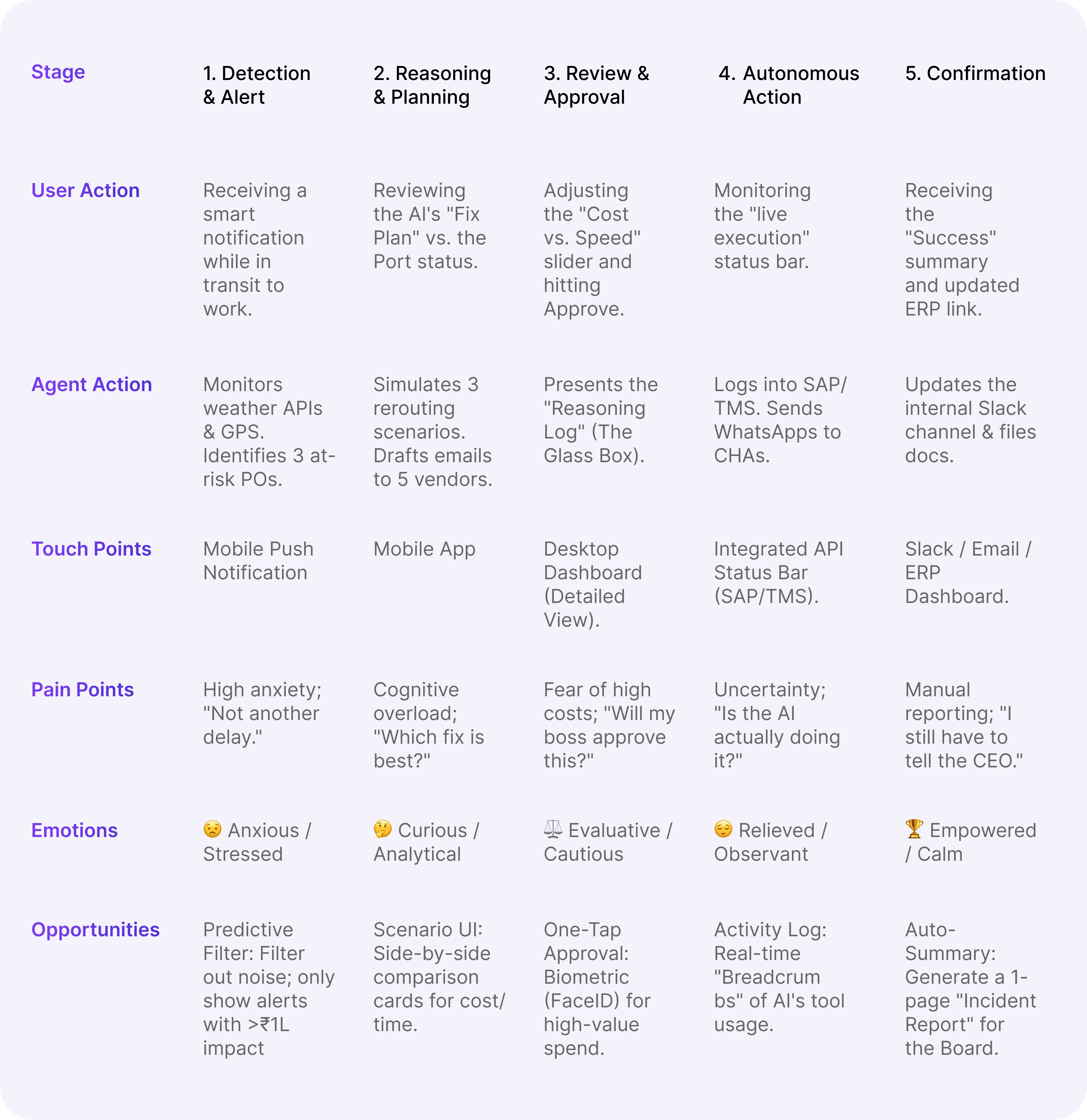
User Journey Mapping
User Journey Mapping
1. Detection & Alert
Receiving a smart notification while in transit to work.
Monitors weather APIs & GPS. Identifies 3 at risk POs.
Mobile Push Notification
High anxiety; "Not another delay."
😟 Anxious / Stressed
Predictive Filter: Filter out noise; only show alerts with >₹1L impact
🤔 Curious / Analytical
Scenario UI: Side by side comparison cards for cost/time.
⚖️ Evaluative / Cautious
One-Tap Approval: Biometric (FaceID) for high-value spend.
😌 Relieved / Observant
Activity Log: Real-time "Breadcrumbs" of AI's tool usage.
🏆 Empowered / Calm
Auto-Summary: Generate a 1 page "Incident Report" for the Board.
Simulates 3 rerouting scenarios. Drafts emails to 5 vendors.
Mobile App
Cognitive overload; "Which fix is best?"
Presents the "Reasoning Log" (The Glass Box).
Desktop Dashboard (Detailed View).
Fear of high costs; "Will my boss approve this?"
Logs into SAP/TMS. Sends WhatsApps to CHAs.
Integrated API Status Bar (SAP/TMS).
Uncertainty; "Is the AI actually doing it?"
Updates the internal Slack channel & files docs.
Slack / Email / ERP Dashboard.
Manual reporting; "I still have to tell the CEO."
2. Reasoning & Planning
Reviewing the AI's "Fix Plan" vs. the Port status.
3. Review & Approval
Adjusting the "Cost vs. Speed" slider and hitting Approve.
Autonomous Action
Monitoring the "live execution" status bar.
5. Confirmation
Receiving the "Success" summary and updated ERP link.
Stage
User Action
Pain Points
Emotions
Opportunities
Agent Action
Touch Points
The Scenario: "The Monsoon Bottleneck"
The Scenario: "The Monsoon Bottleneck"
A massive rainstorm in Maharashtra has caused a 48 hour backlog at the JNPT Port (Mumbai). Arjun’s company has a "Just in Time" production deadline in Pune for their new smartphone launch.
A massive rainstorm in Maharashtra has caused a 48 hour backlog at the JNPT Port (Mumbai). Arjun’s company has a "Just in Time" production deadline in Pune for their new smartphone launch.
User FLOW
User FLOW
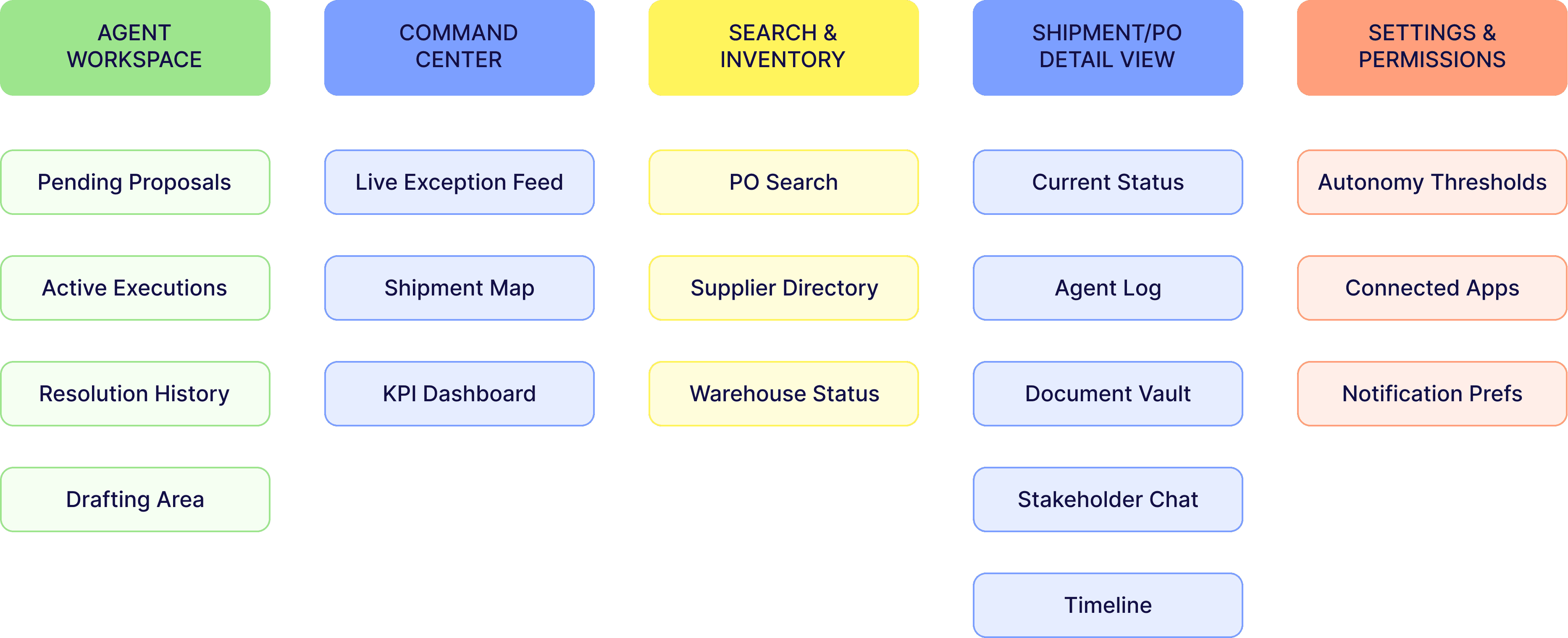
This IA is designed to show the hierarchy of the platform, specifically highlighting how the "Agent" lives as a core pillar alongside traditional supply chain data.
We use colors to distinguish between Passive Monitoring (Blue), Active Agent Actions (Green), and System Controls (Orange).
Information Architecture
Information Architecture
Final Designs
Final Designs
Agent Workspace
Command Center
Shipment/PO Detail View
Search & Inventory
Settings & Permissions
Pending Proposals
Live Exception Feed
Current Status
PO Search
Autonomy Thresholds
Active Executions
Supplier Directory
Warehouse Status
Connected Apps
Resolution History
Shipment Map
Agent Log
Notification Prefs
Drafting Area
KPI Dashboard
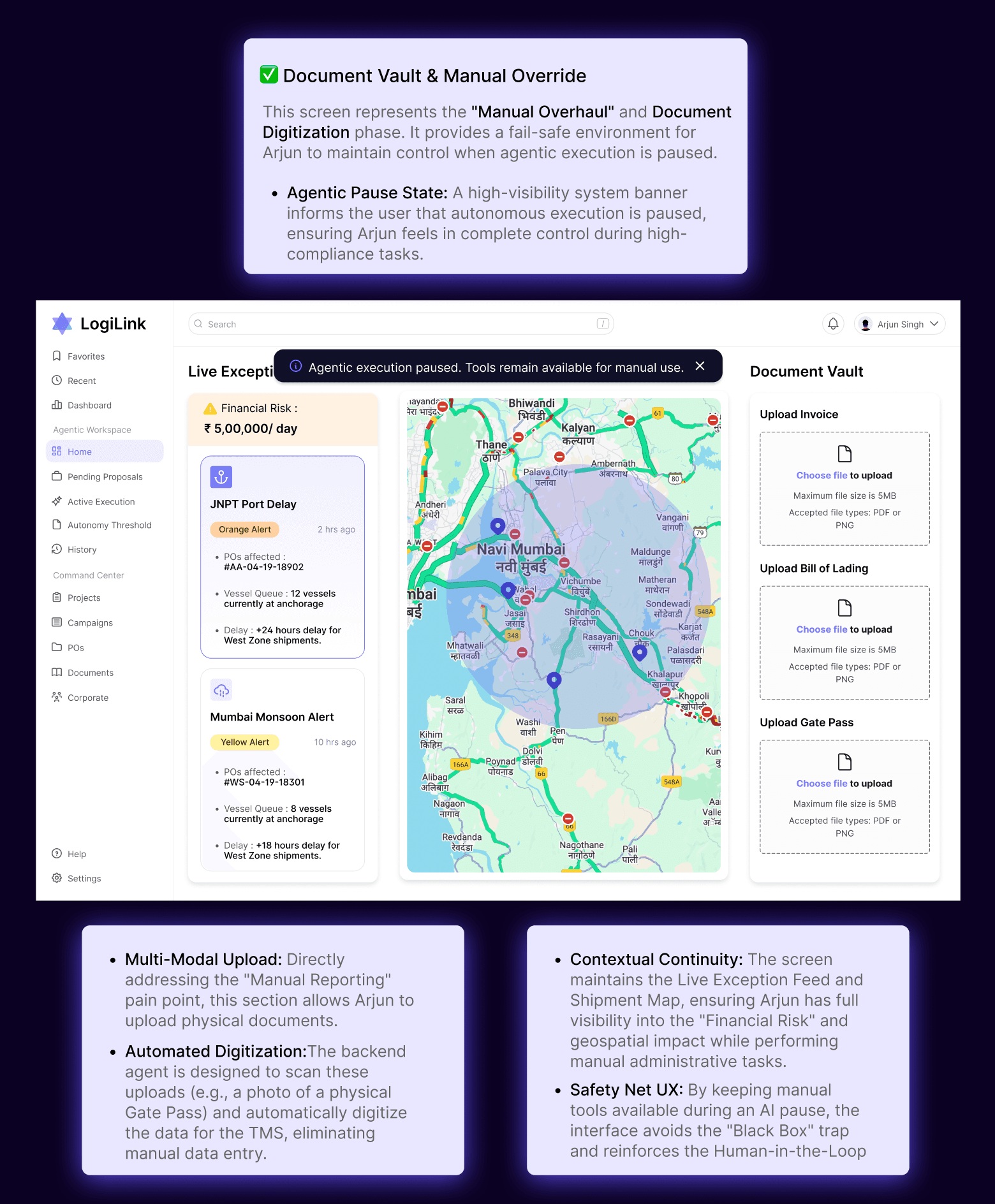
Document Vault
Stakeholder Chat
Timeline
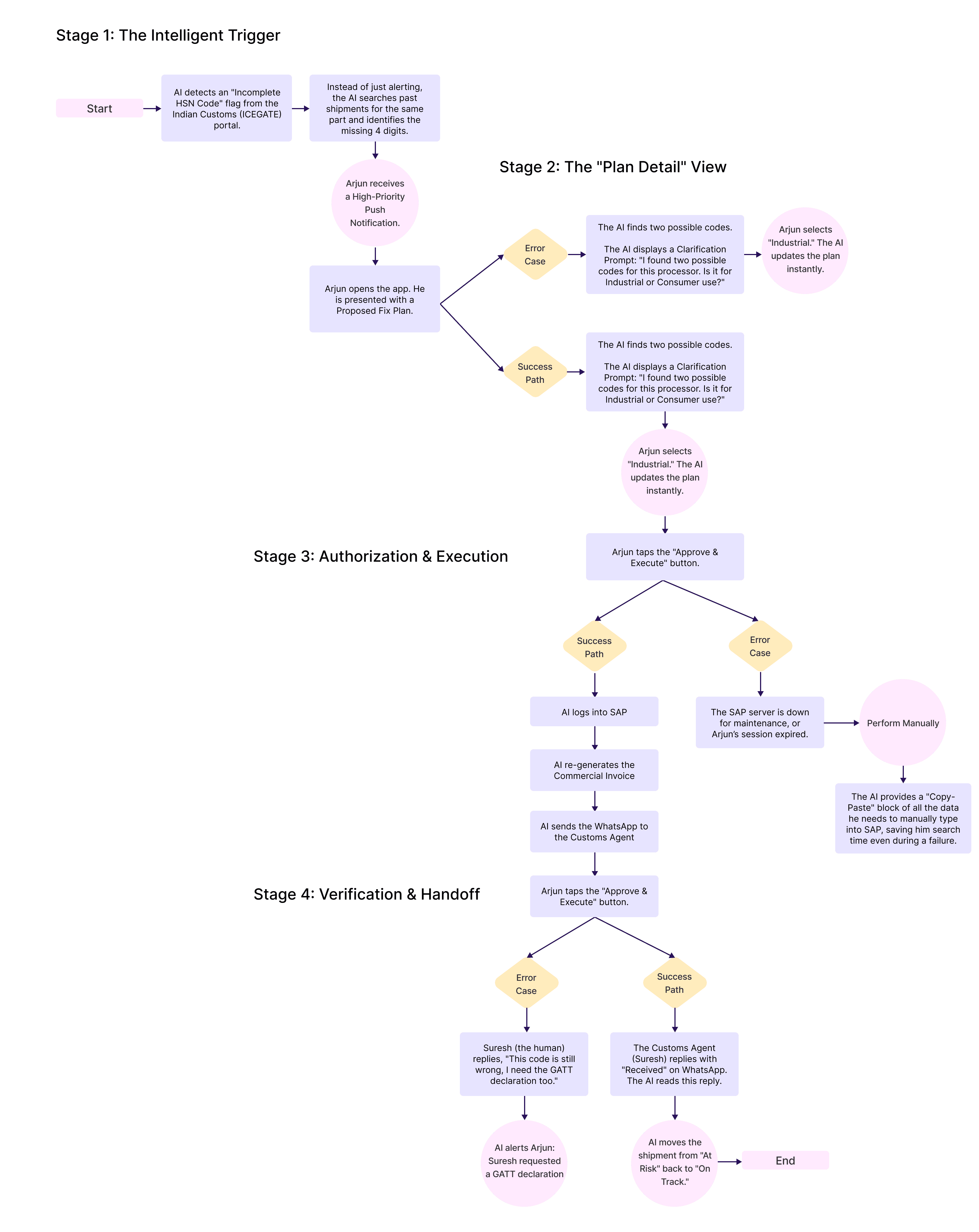
Below is the detailed flow for Arjun using the LogiLink Mobile App to handle a "Customs Documentation Error."
Agentic User Flow: "The Customs Correction"
Below is the detailed flow for Arjun using the LogiLink Mobile App to handle a "Customs Documentation Error."
Agentic User Flow: "The Customs Correction"
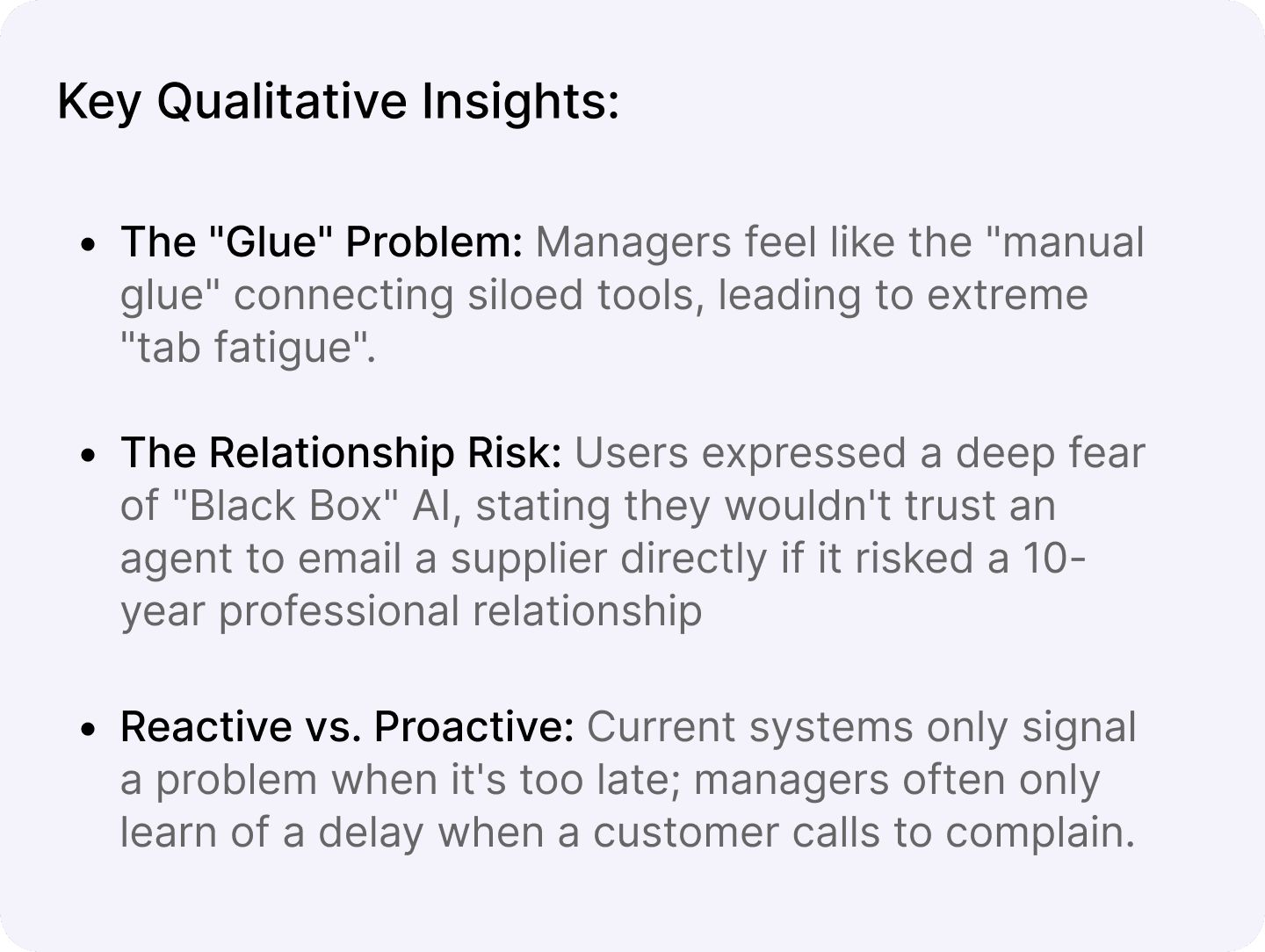
Key Qualitative Insights:
The "Glue" Problem: Managers feel like the "manual glue" connecting siloed tools, leading to extreme "tab fatigue".
The Relationship Risk: Users expressed a deep fear of "Black Box" AI, stating they wouldn't trust an agent to email a supplier directly if it risked a 10 year professional relationship
Reactive vs. Proactive: Current systems only signal a problem when it's too late; managers often only learn of a delay when a customer calls to complain.
the "Agentic" Phases
the "Agentic" Phases
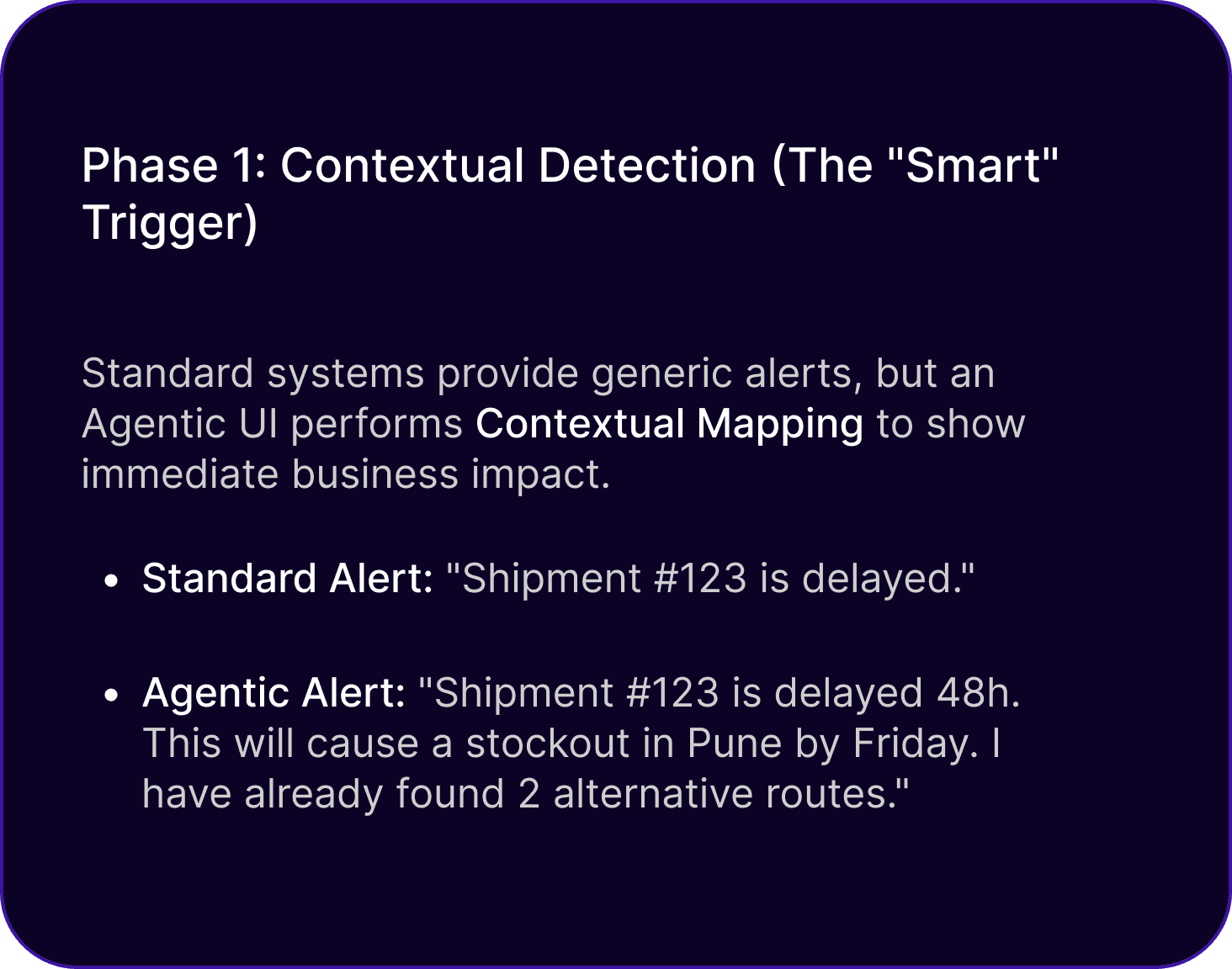
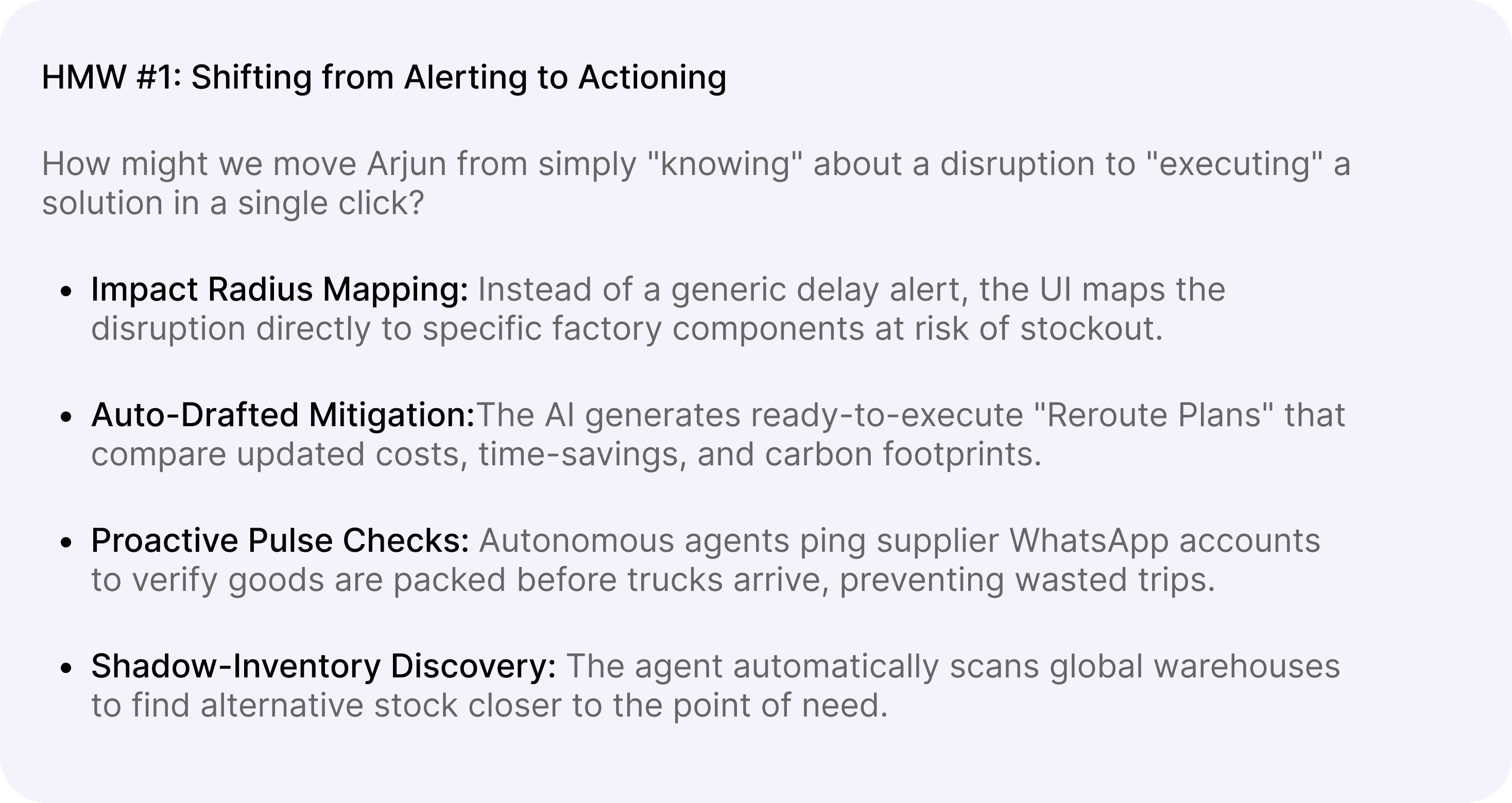
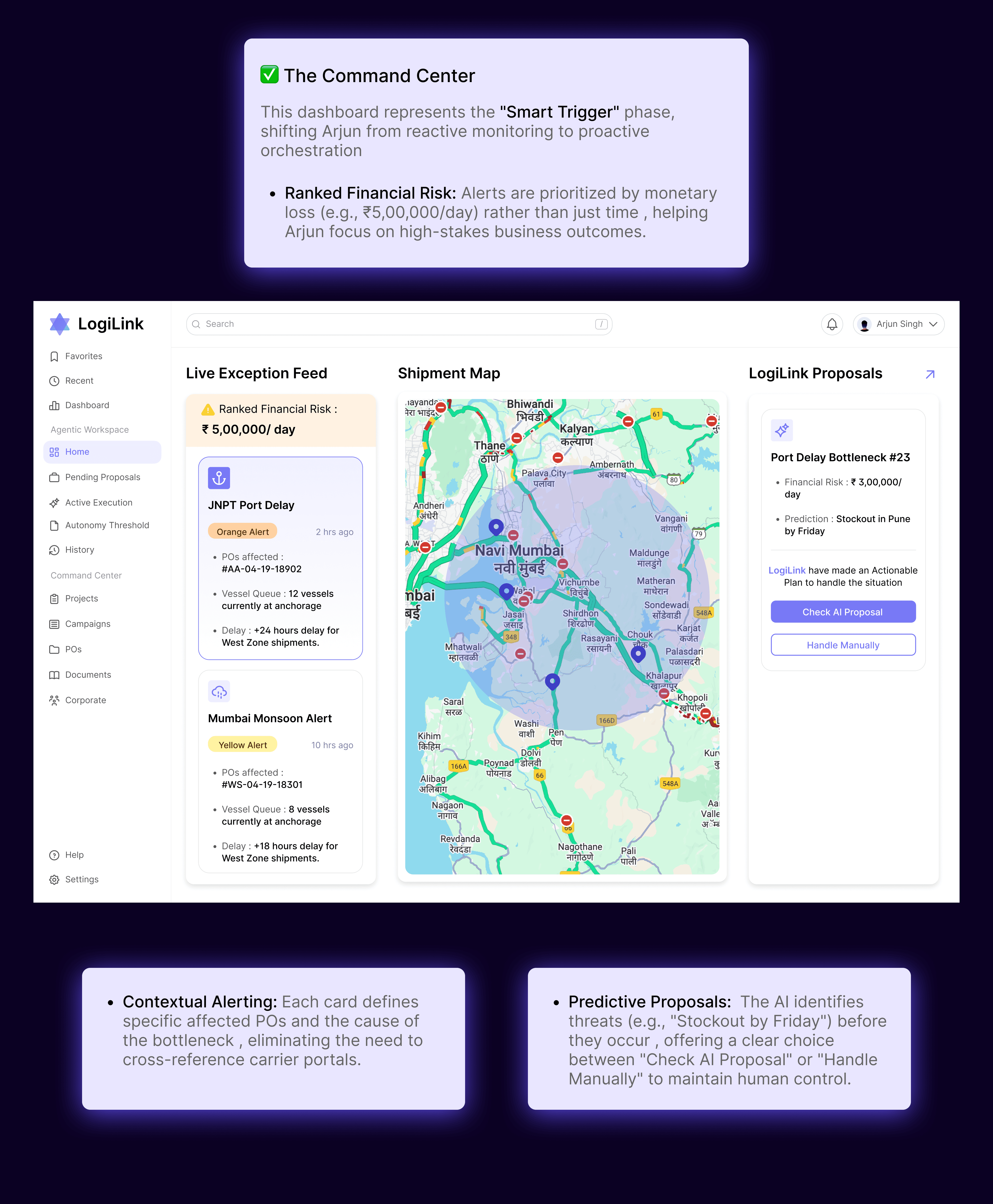
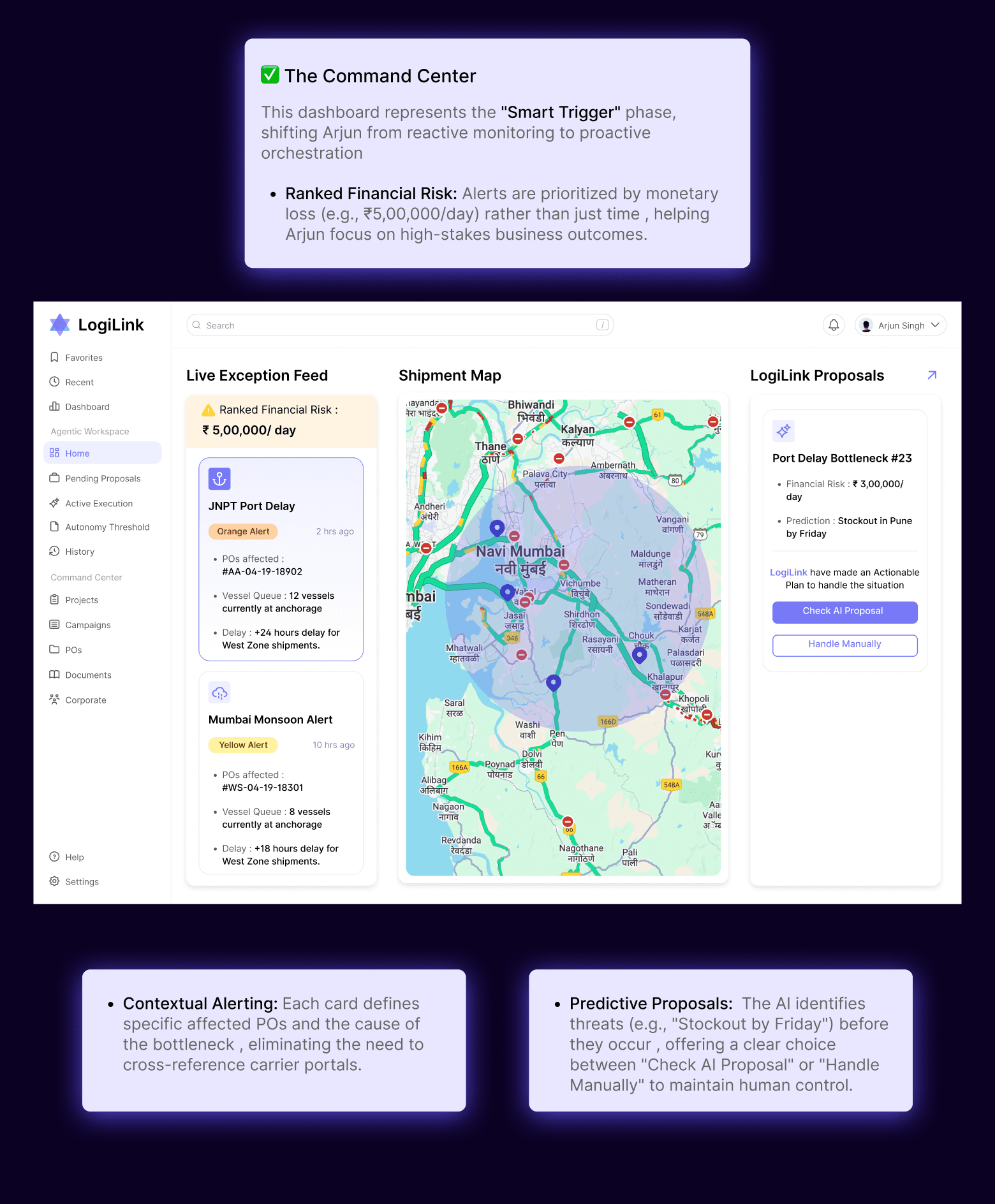
Phase 1: Contextual Detection (The "Smart" Trigger)
Standard Alert: "Shipment #123 is delayed."
Agentic Alert: "Shipment #123 is delayed 48h. This will cause a stockout in Pune by Friday. I have already found 2 alternative routes."
Standard systems provide generic alerts, but an Agentic UI performs Contextual Mapping to show immediate business impact.
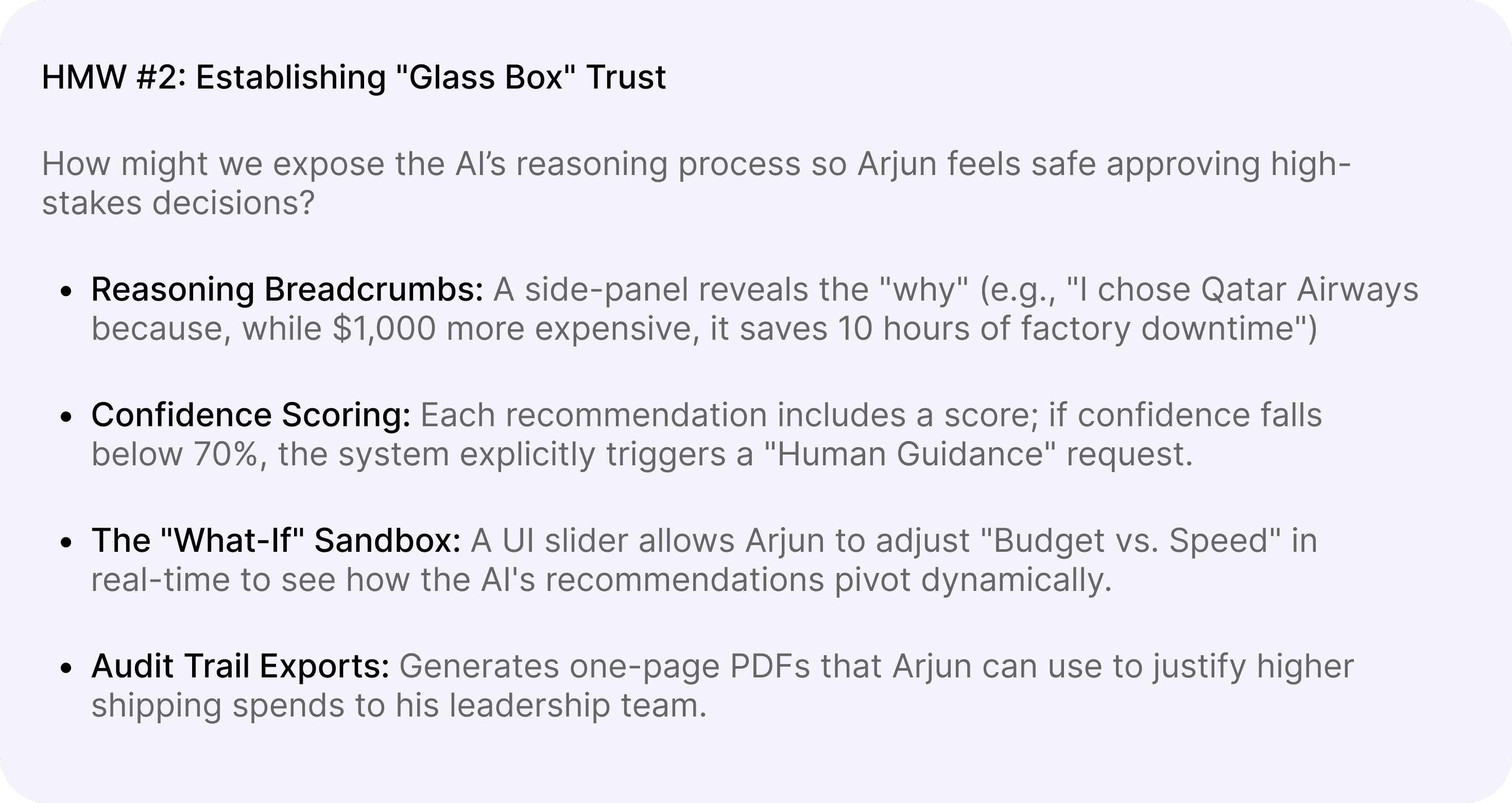
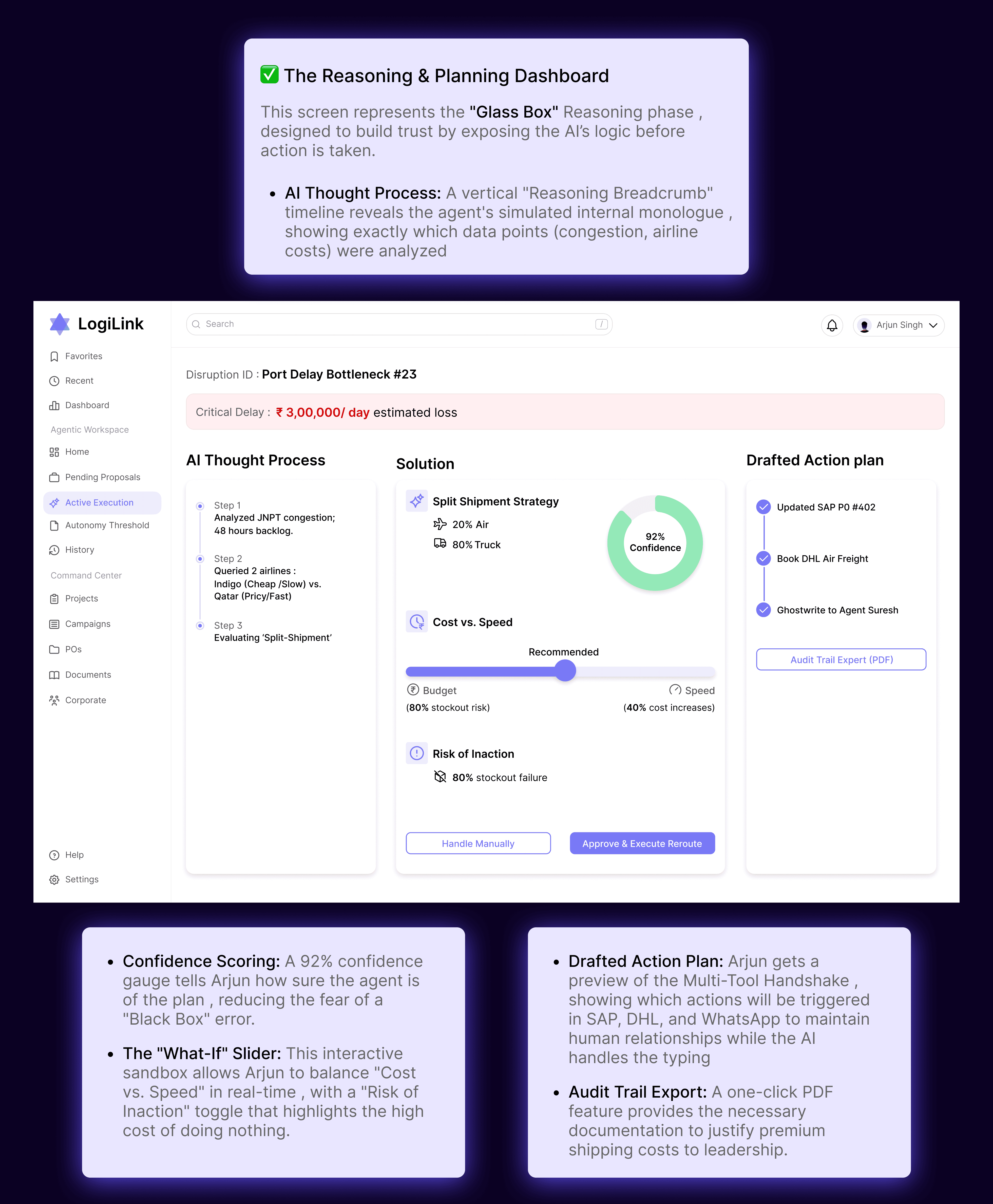
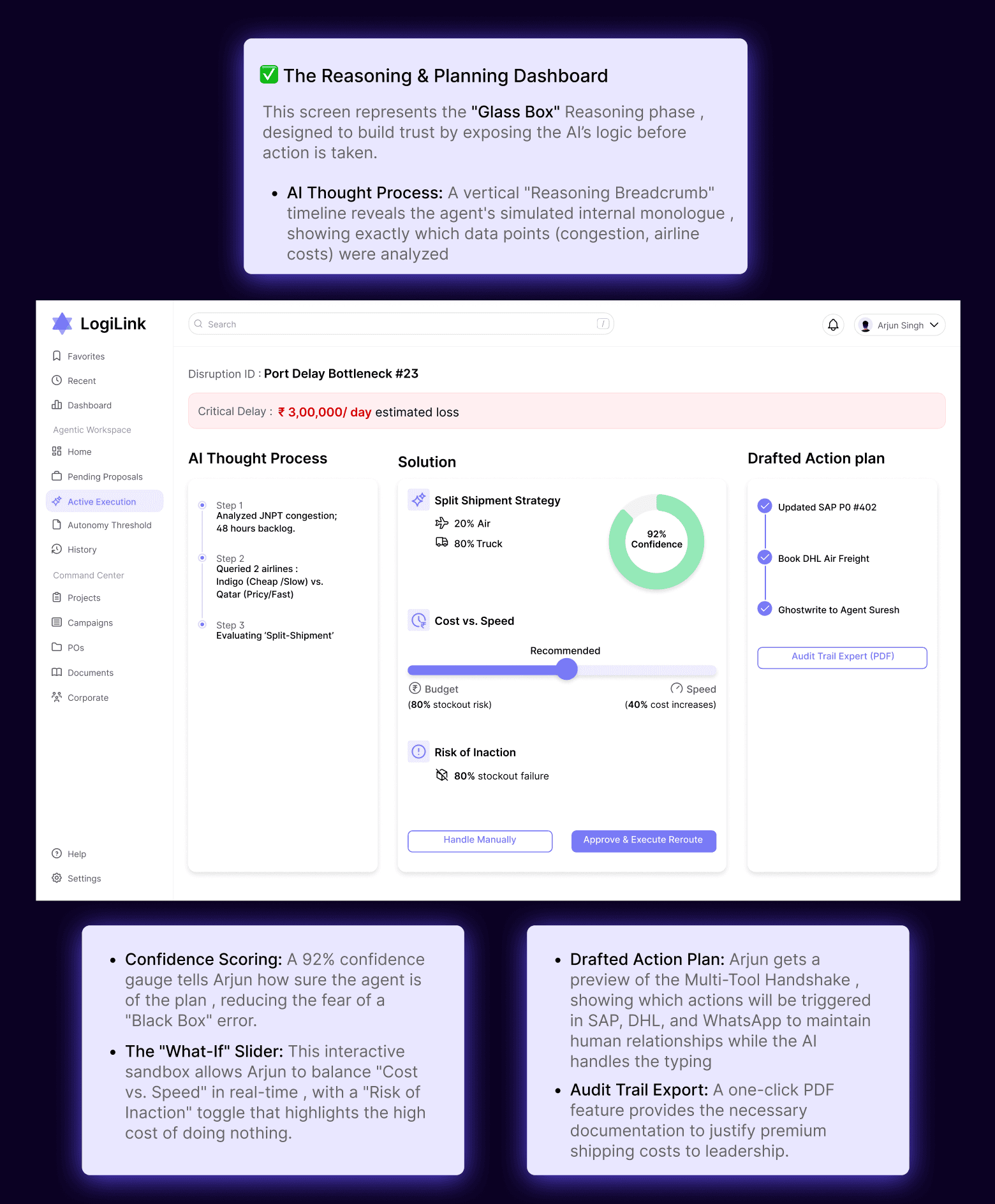
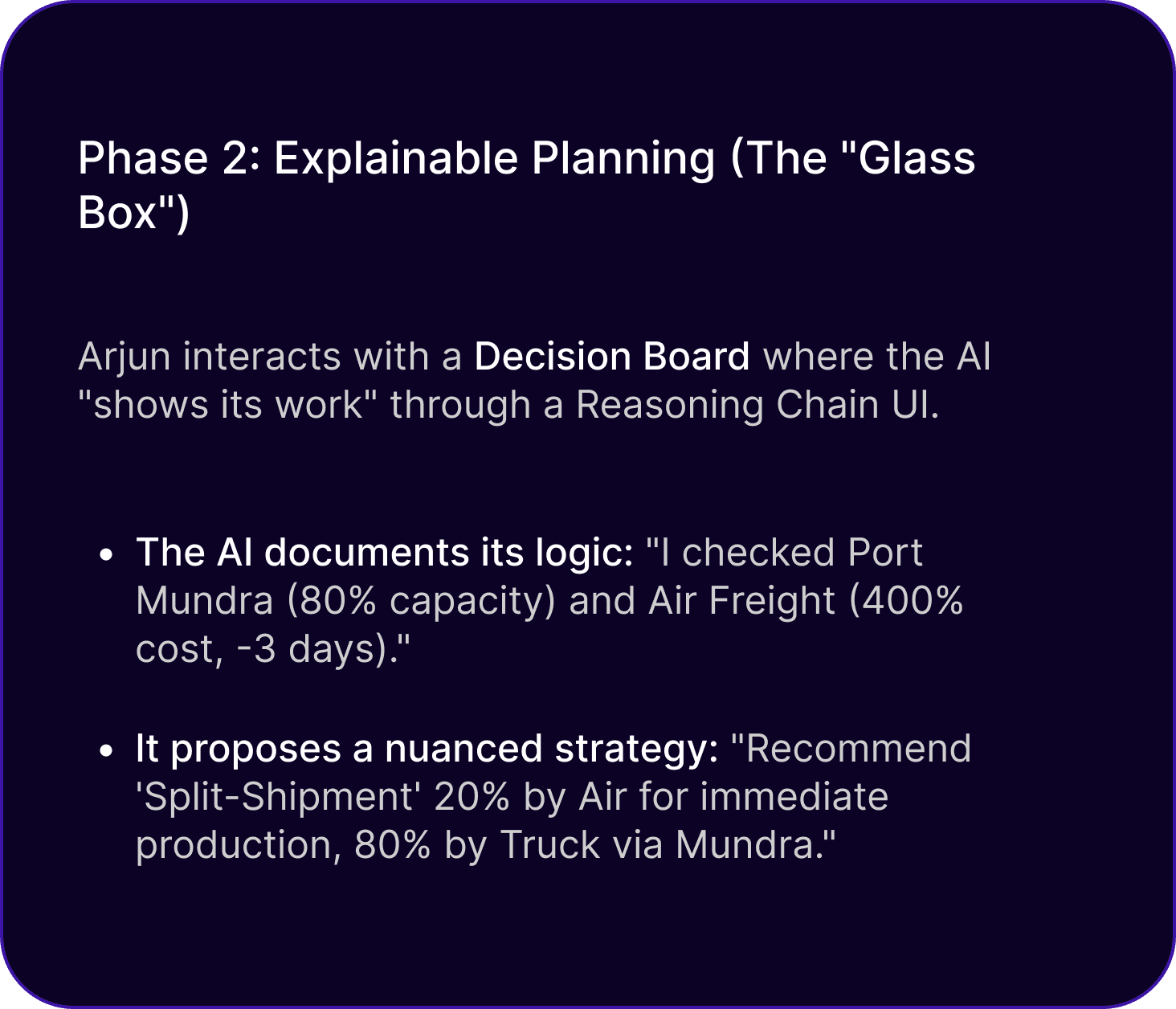
Phase 2: Explainable Planning (The "Glass Box")
The AI documents its logic: "I checked Port Mundra (80% capacity) and Air Freight (400% cost, -3 days)."
It proposes a nuanced strategy: "Recommend 'Split Shipment' 20% by Air for immediate production, 80% by Truck via Mundra."
Arjun interacts with a Decision Board where the AI "shows its work" through a Reasoning Chain UI.
This IA is designed to show the hierarchy of the platform, specifically highlighting how the "Agent" lives as a core pillar alongside traditional supply chain data.
We use colors to distinguish between Passive Monitoring (Blue), Active Agent Actions (Green), and System Controls (Orange).
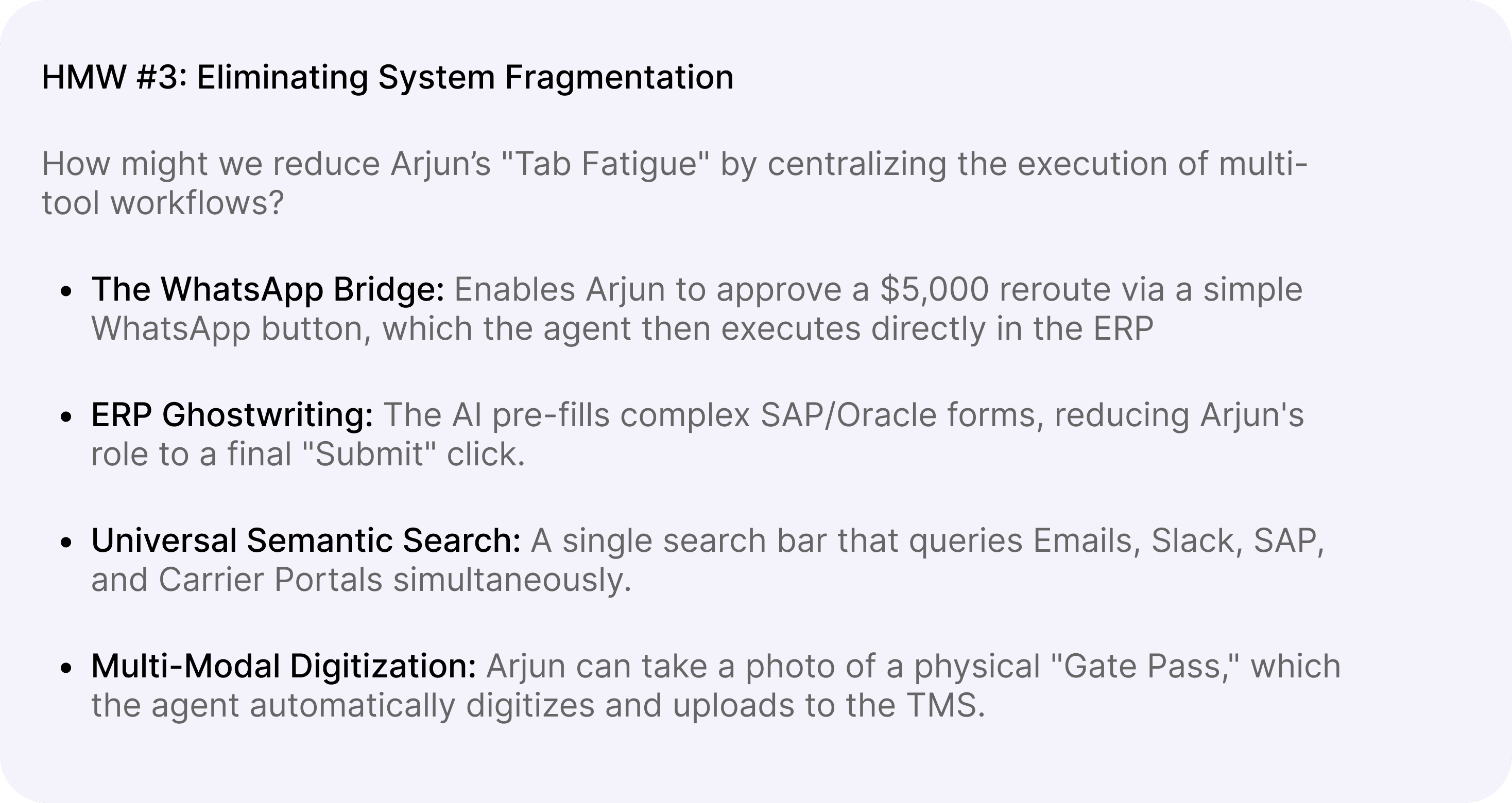
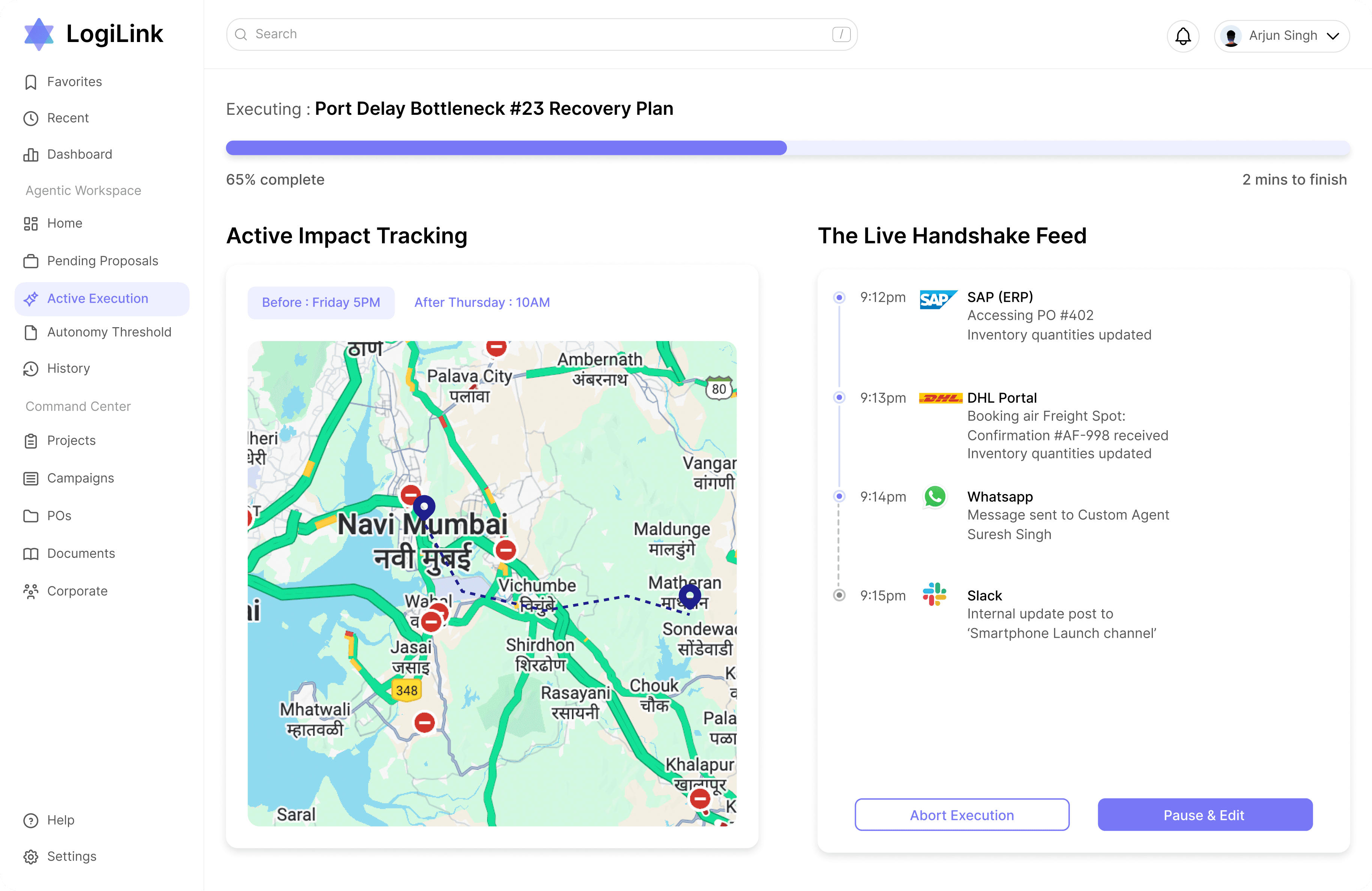
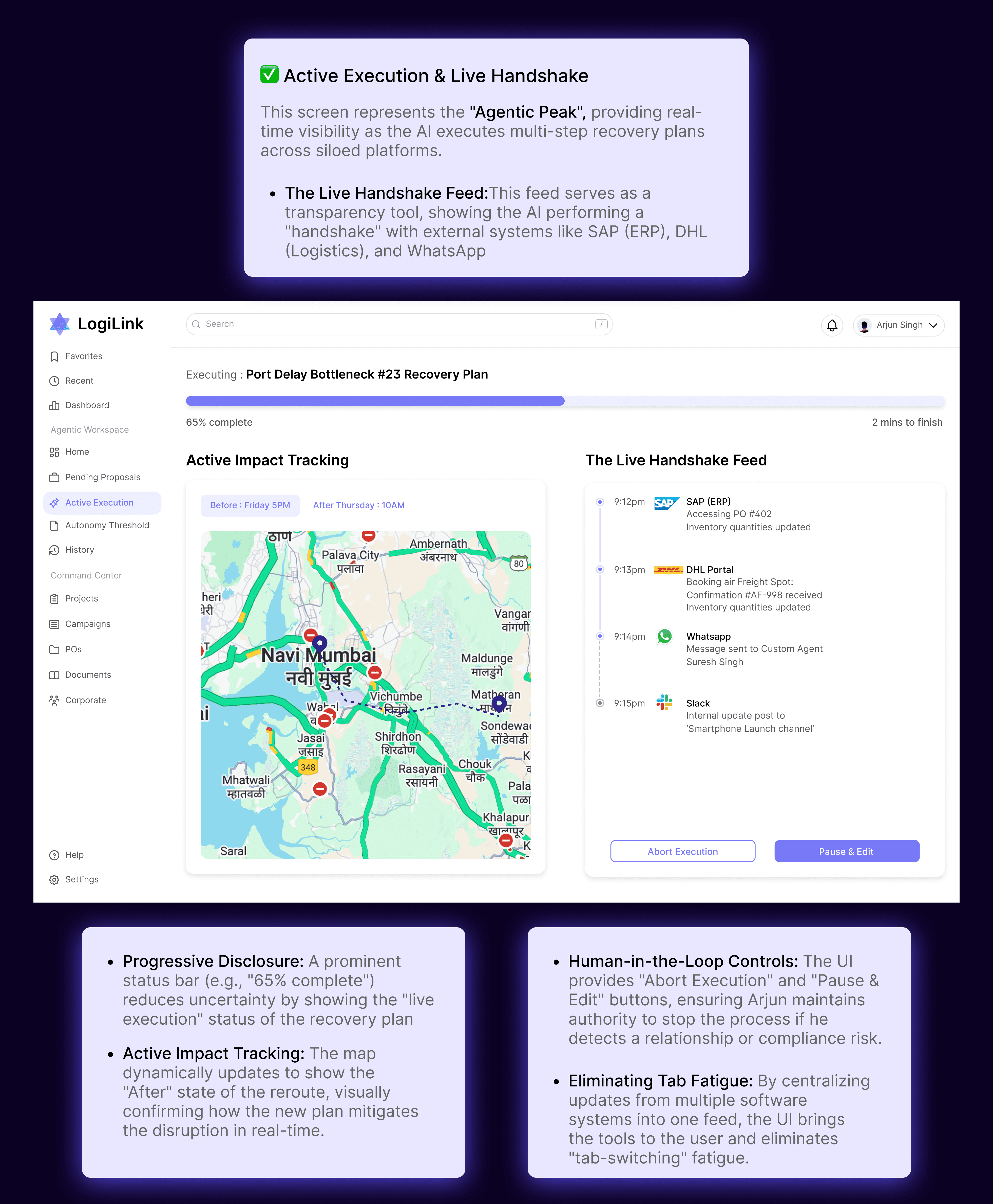
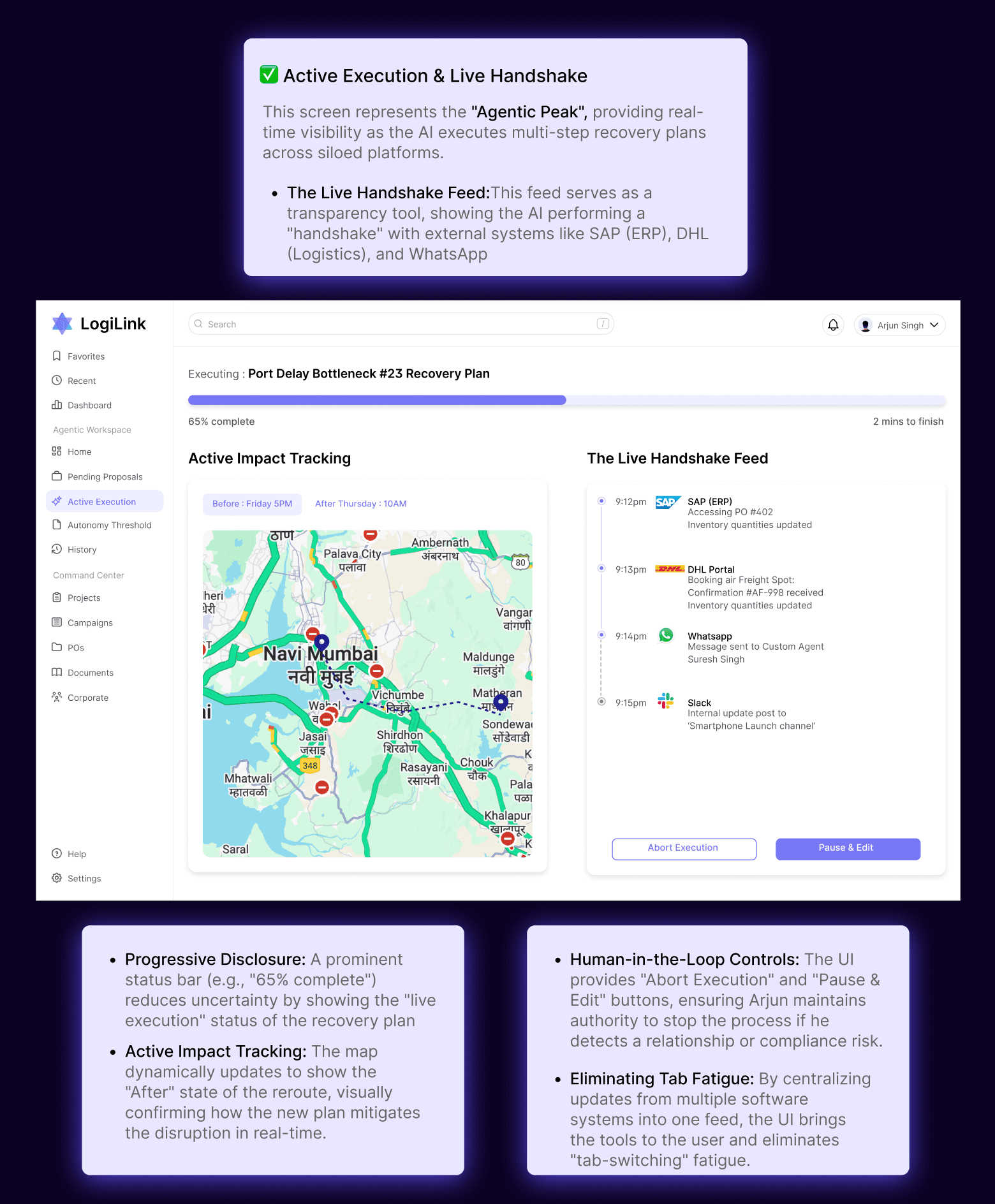
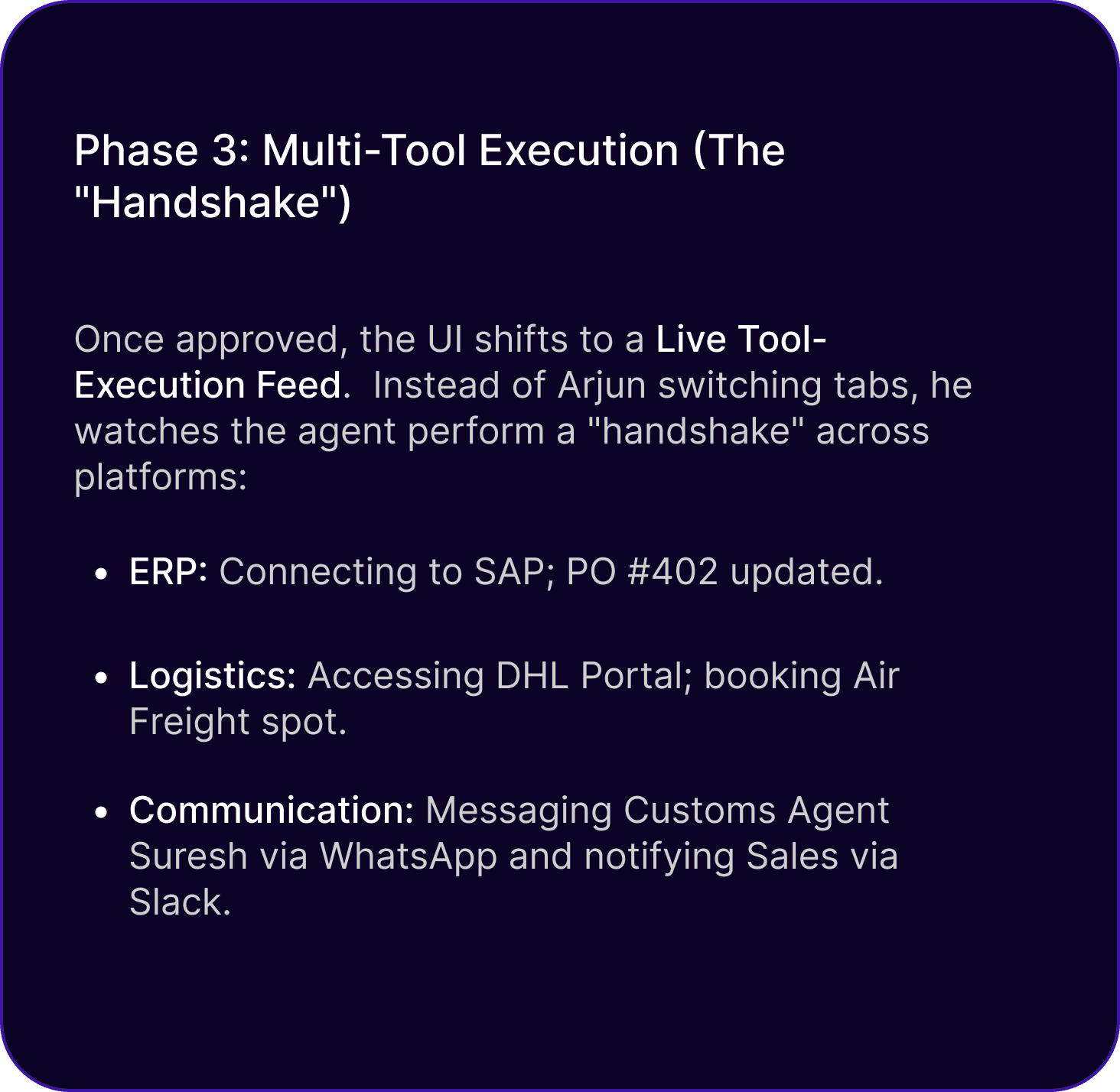
Phase 3: Multi-Tool Execution (The "Handshake")
ERP: Connecting to SAP; PO #402 updated.
Logistics: Accessing DHL Portal; booking Air Freight spot.
Communication: Messaging Customs Agent Suresh via WhatsApp and notifying Sales via Slack.
Once approved, the UI shifts to a Live Tool Execution Feed. Instead of Arjun switching tabs, he watches the agent perform a "handshake" across platforms:
UX Opportunities Identified
UX Opportunities Identified
During the design process, I identified three critical opportunities to balance AI autonomy with human control:
During the design process, I identified three critical opportunities to balance AI autonomy with human control:
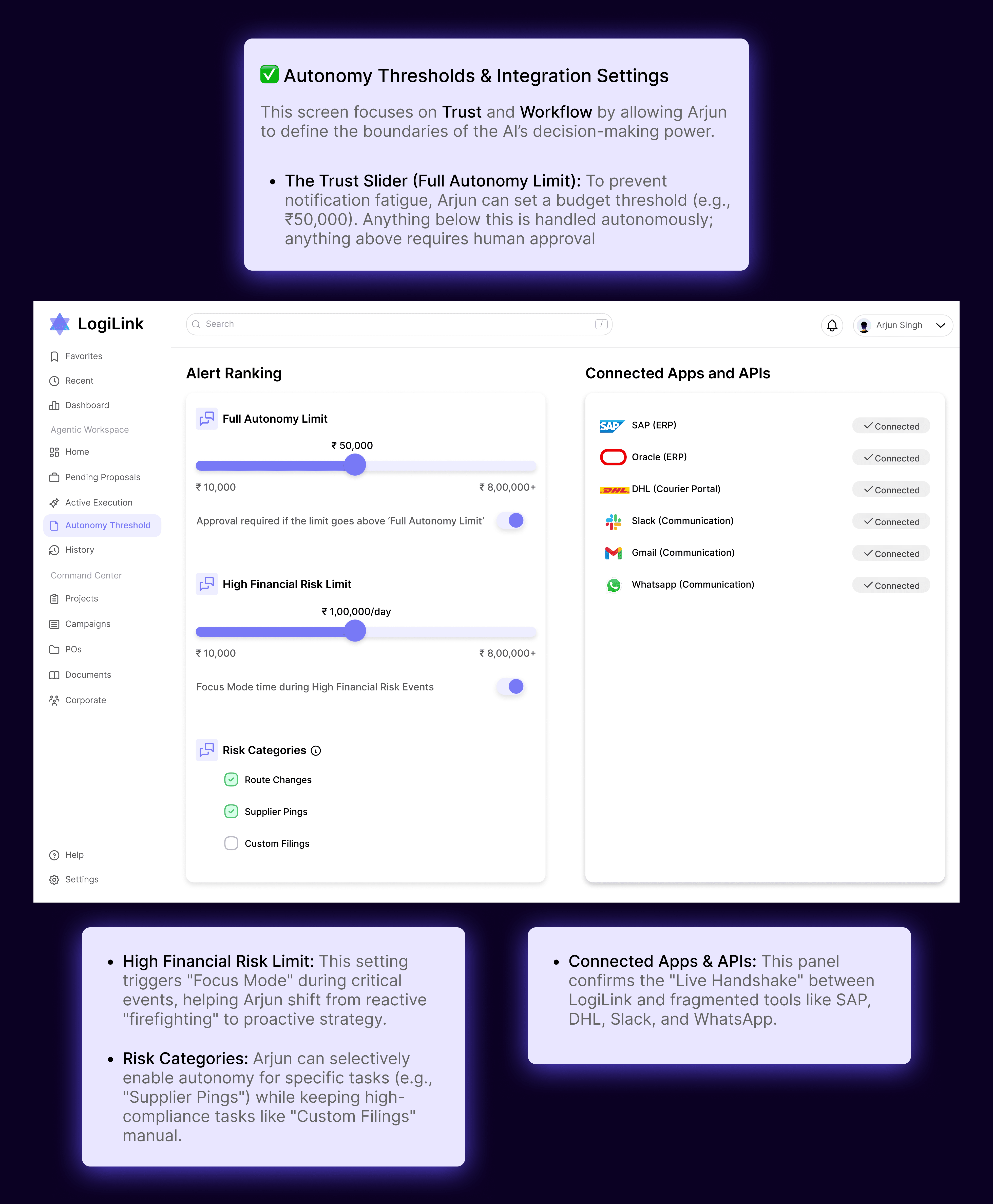
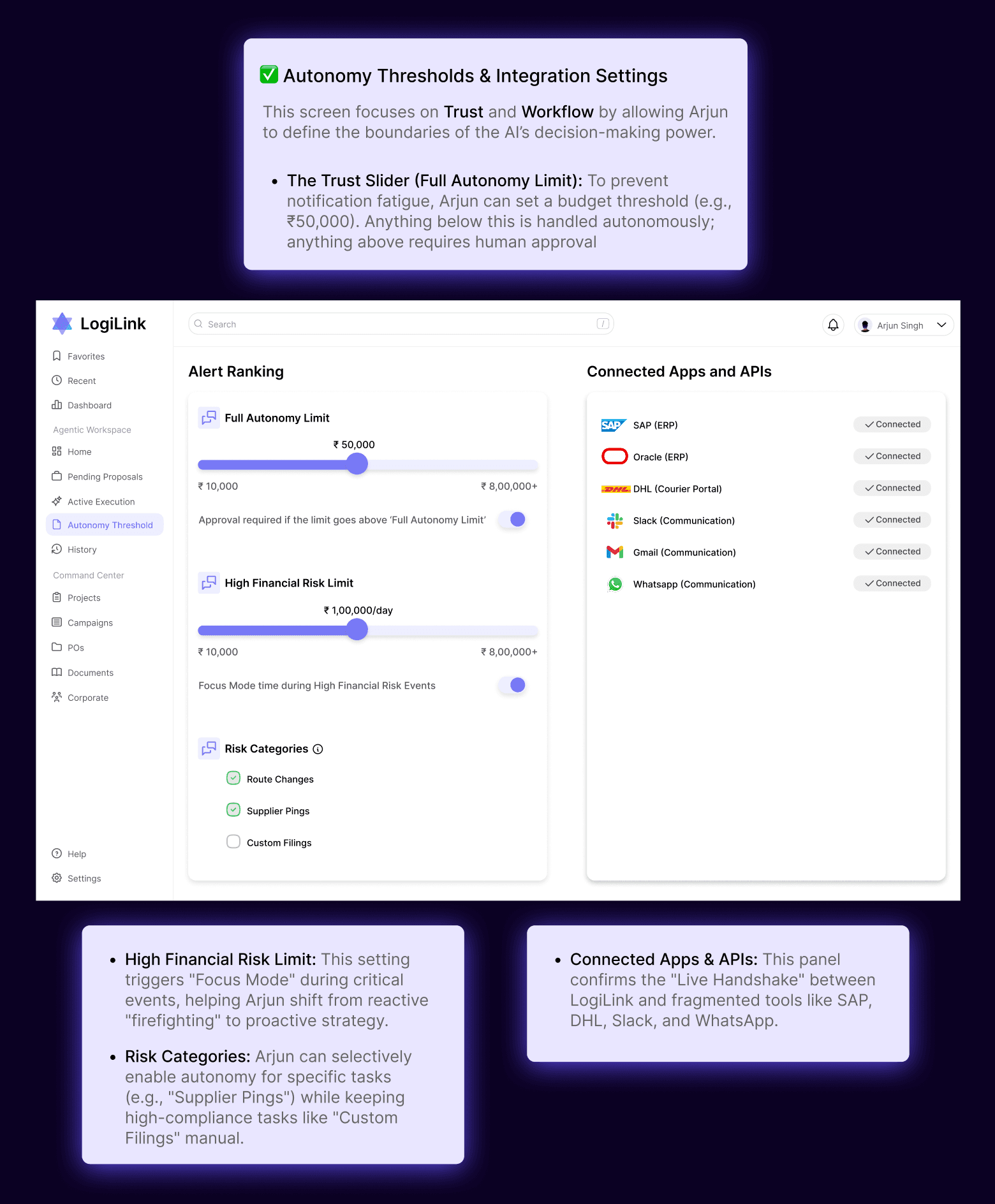
The "Trust Slider" (Dynamic Autonomy): To prevent notification fatigue, Arjun can set a budget threshold (e.g., ₹50,000). Anything under this limit allows "Full Autonomy," while anything above requires a "Human-in-the-Loop" approval.
The "Trust Slider" (Dynamic Autonomy): To prevent notification fatigue, Arjun can set a budget threshold (e.g., ₹50,000). Anything under this limit allows "Full Autonomy," while anything above requires a "Human-in-the-Loop" approval.
The "Risk of Inaction" Sandbox: To combat decision paralysis, I designed a toggle that uses loss-aversion. It simulates the cost of doing nothing (e.g., "If you ignore this, you lose ₹12,00,000 in missed sales by Monday")
The "Risk of Inaction" Sandbox: To combat decision paralysis, I designed a toggle that uses loss-aversion. It simulates the cost of doing nothing (e.g., "If you ignore this, you lose ₹12,00,000 in missed sales by Monday")
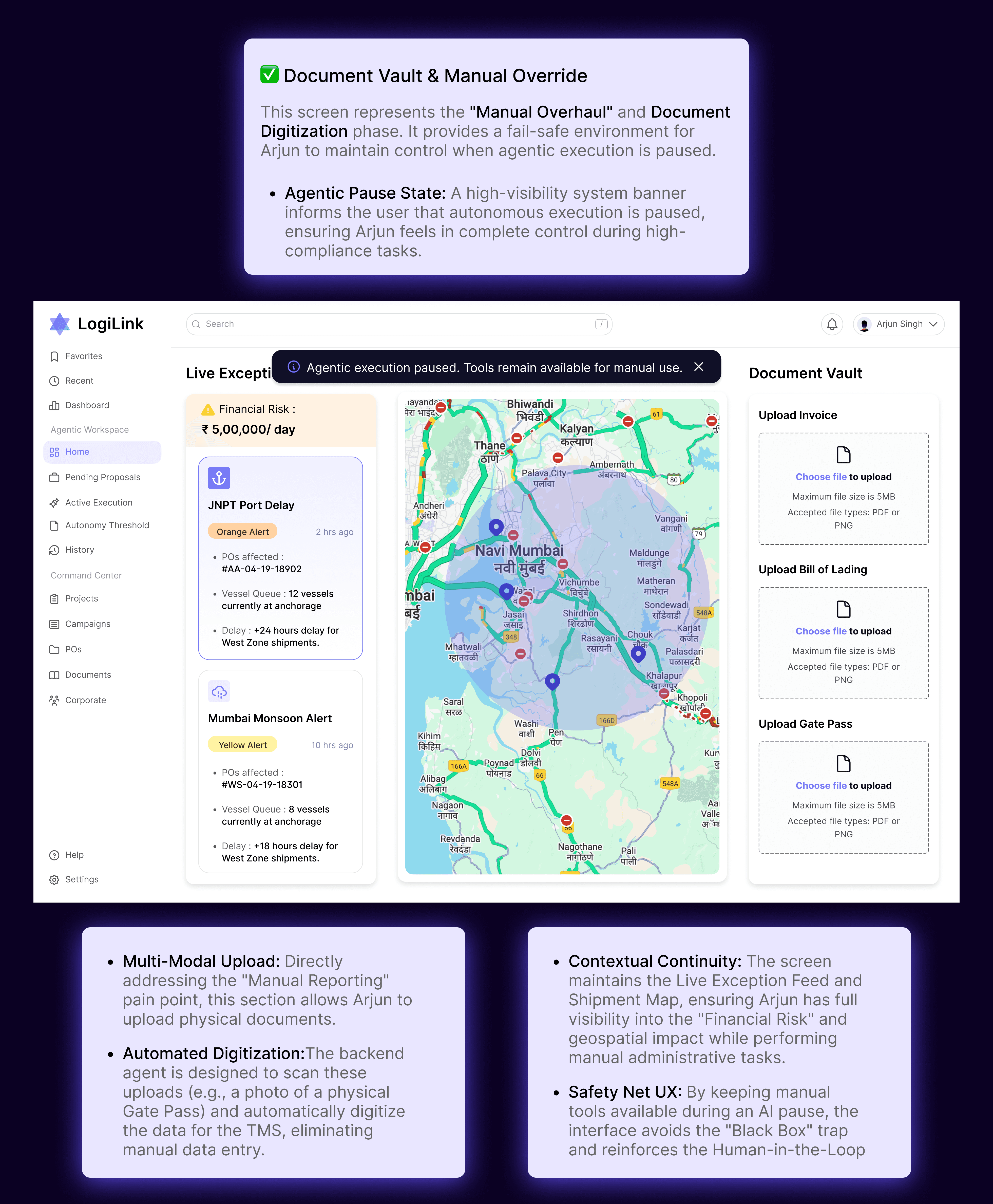
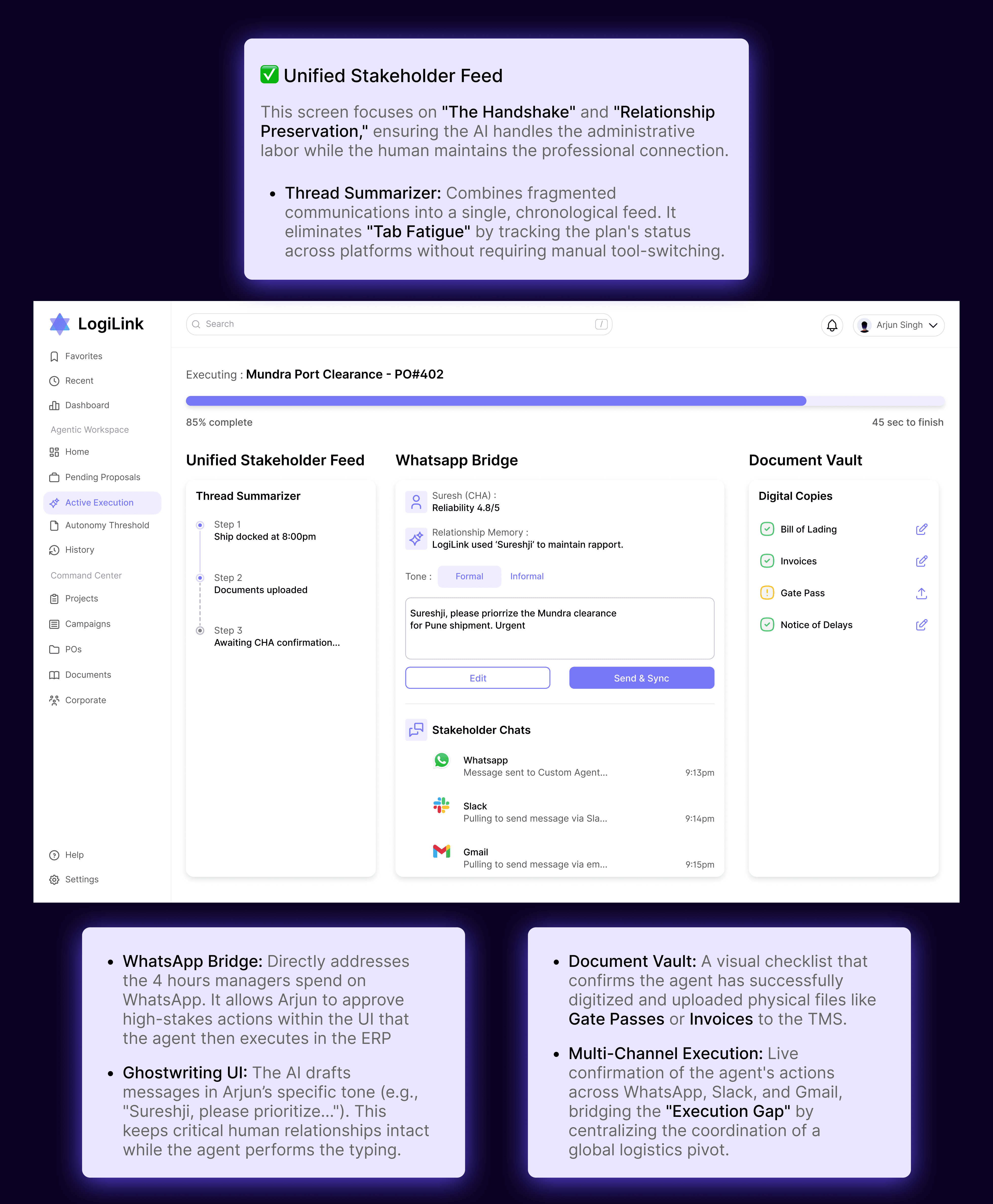
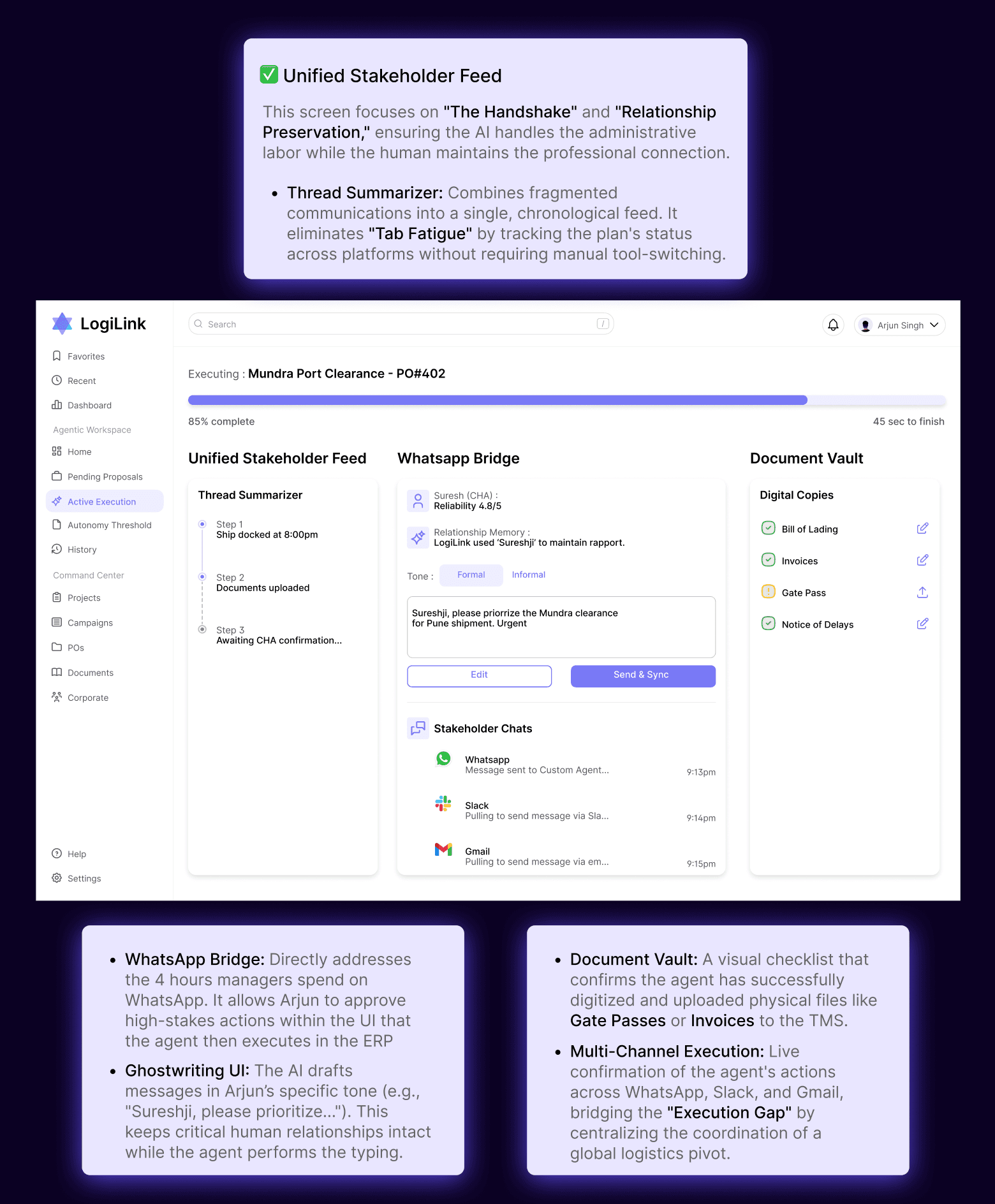
Ghostwriting UI (Relationship Preservation): Since logistics relies on personal relationships, the AI drafts messages in Arjun’s specific tone for Indian vendors (e.g., "Suresh, please prioritize Mundra clearance"). This allows the agent to handle the typing while Arjun maintains the human connection.
Ghostwriting UI (Relationship Preservation): Since logistics relies on personal relationships, the AI drafts messages in Arjun’s specific tone for Indian vendors (e.g., "Suresh, please prioritize Mundra clearance"). This allows the agent to handle the typing while Arjun maintains the human connection.
Error Case
Error Case
Success Path
Success Path
Success Path
Error Case
Stage 1: The Intelligent Trigger
Stage 2: The "Plan Detail" View
Stage 3: Authorization & Execution
Stage 4: Verification & Handoff
AI detects an "Incomplete HSN Code" flag from the Indian Customs (ICEGATE) portal.
Instead of just alerting, the AI searches past shipments for the same part and identifies the missing 4 digits.
The AI finds two possible codes.
The AI displays a Clarification Prompt: "I found two possible codes for this processor. Is it for Industrial or Consumer use?"
The AI finds two possible codes.
The AI displays a Clarification Prompt: "I found two possible codes for this processor. Is it for Industrial or Consumer use?"
The SAP server is down for maintenance, or Arjun’s session expired.
AI logs into SAP
AI re-generates the Commercial Invoice
AI sends the WhatsApp to the Customs Agent
The Customs Agent (Suresh) replies with "Received" on WhatsApp. The AI reads this reply.
Suresh (the human) replies, "This code is still wrong, I need the GATT declaration too."
Arjun taps the "Approve & Execute" button.
Arjun taps the "Approve & Execute" button.
The AI provides a "Copy-Paste" block of all the data he needs to manually type into SAP, saving him search time even during a failure.
Arjun opens the app. He is presented with a Proposed Fix Plan.
Arjun selects "Industrial." The AI updates the plan instantly.
Arjun selects "Industrial." The AI updates the plan instantly.
AI alerts Arjun: Suresh requested a GATT declaration
AI moves the shipment from "At Risk" back to "On Track."
Perform Manually
High Cognitive Load & Reaction Lag:
Users are often stuck in "firefighting" mode, only discovering a shipment is late when a customer complains or a factory line stops.
The AI Trust Deficit:
There is significant fear that an autonomous agent might make a high-cost error like ordering 5,000 extra units or damaging a vendor relationship without human oversight.
Tab & Toggle Fatigue:
Managers spend half their day copy-pasting tracking data between siloed systems like SAP, email, and carrier portals, acting as the "human glue" for fragmented data.

user personas
user personas
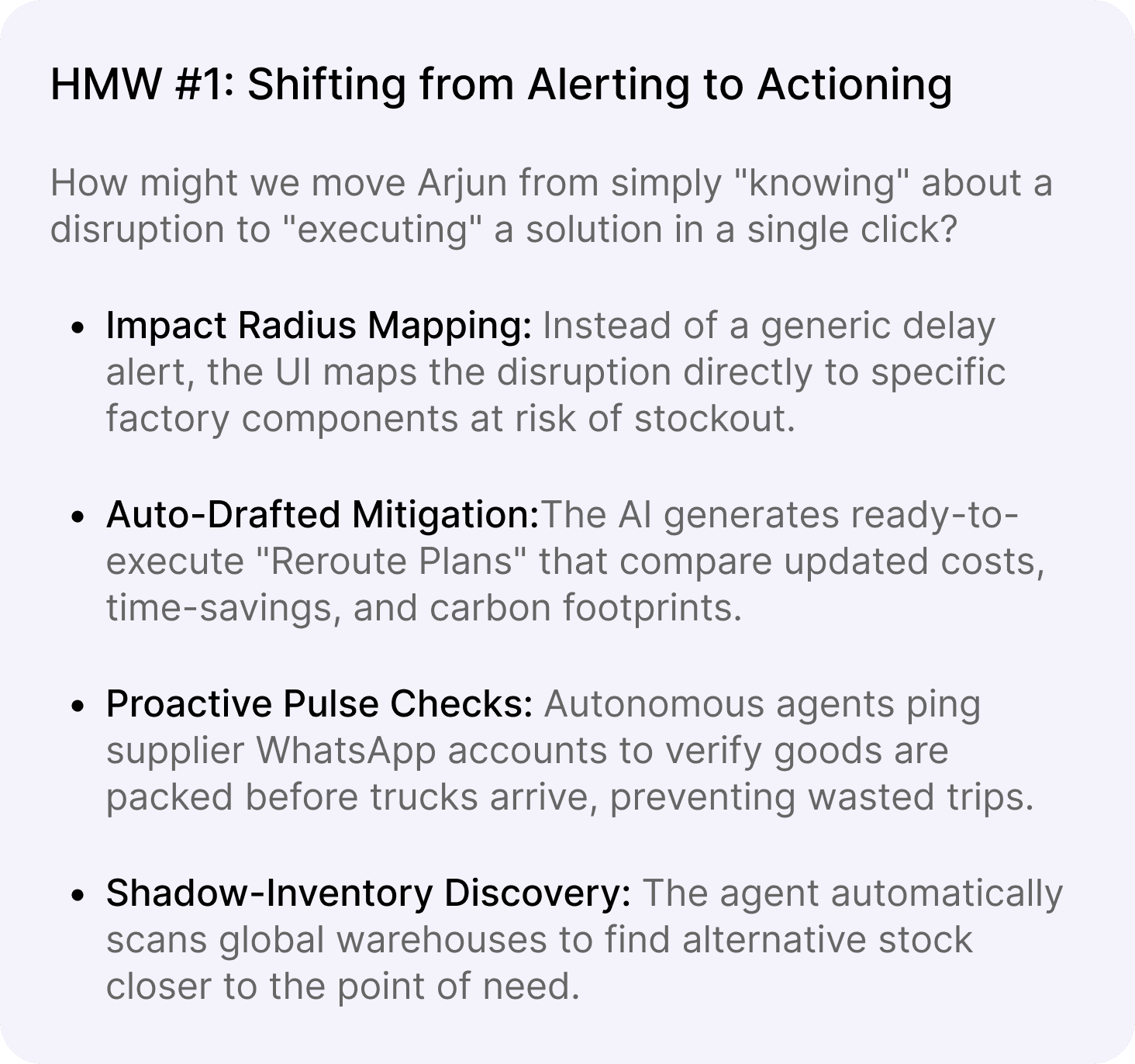
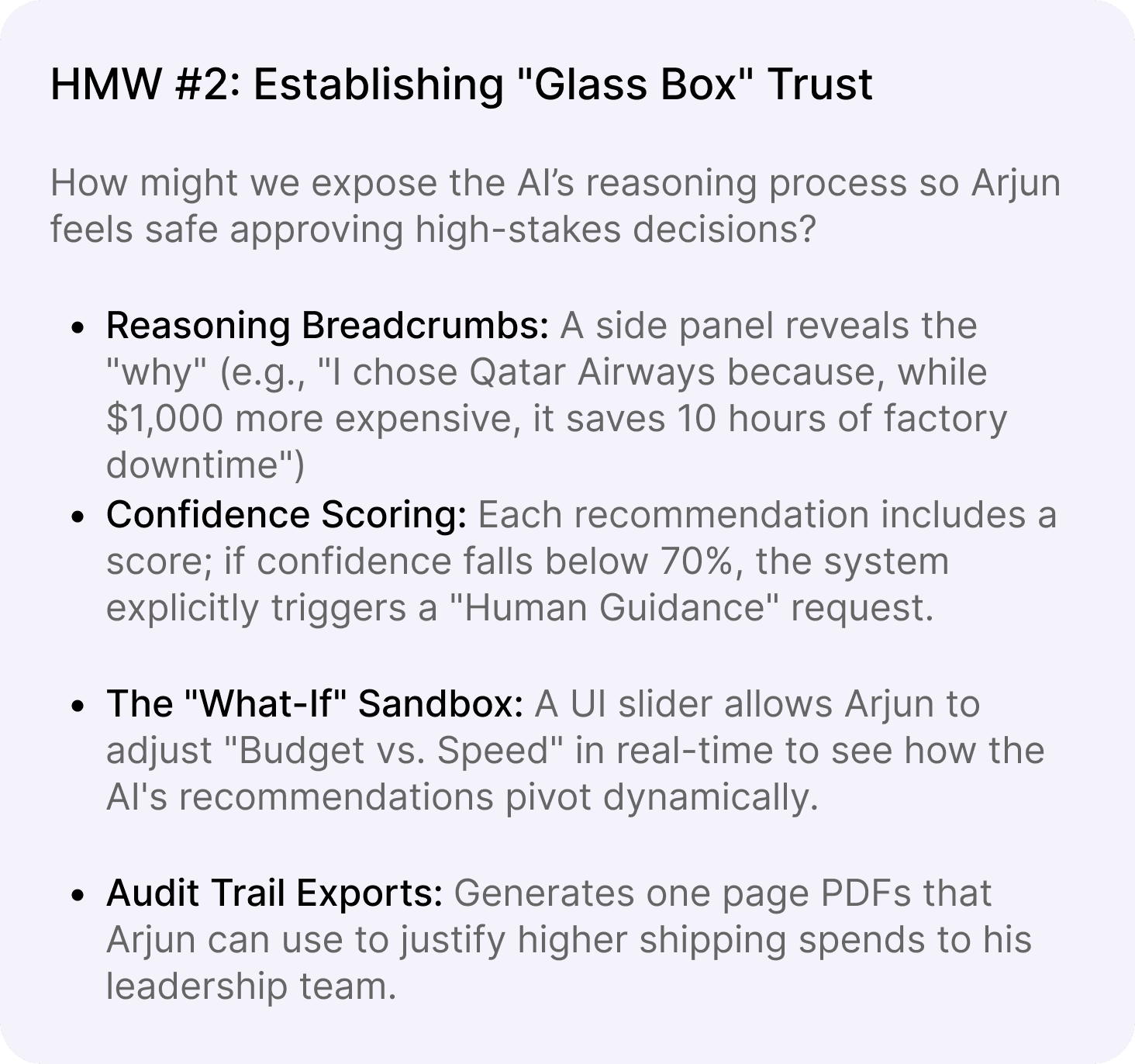
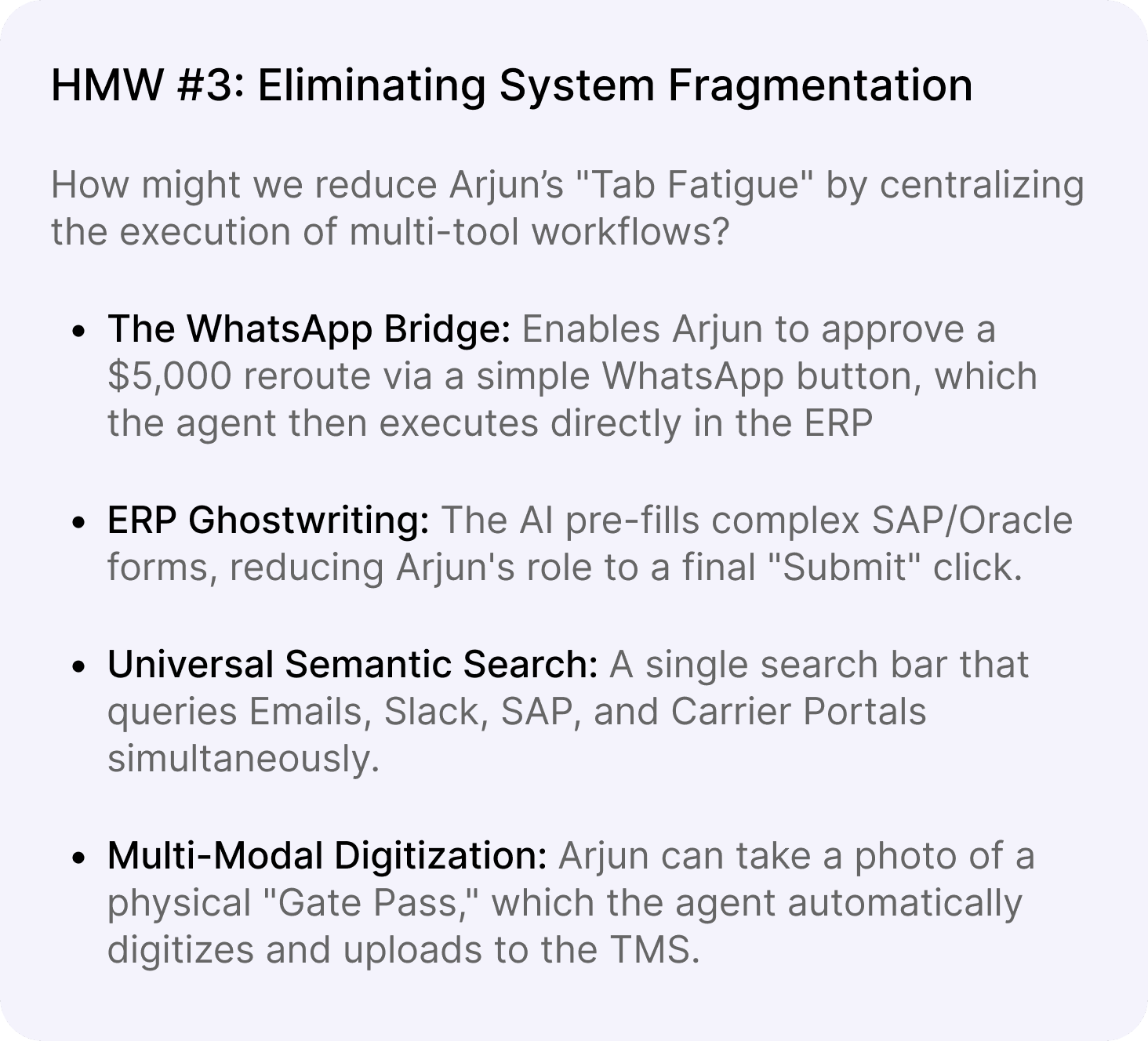
How Might We
How Might We
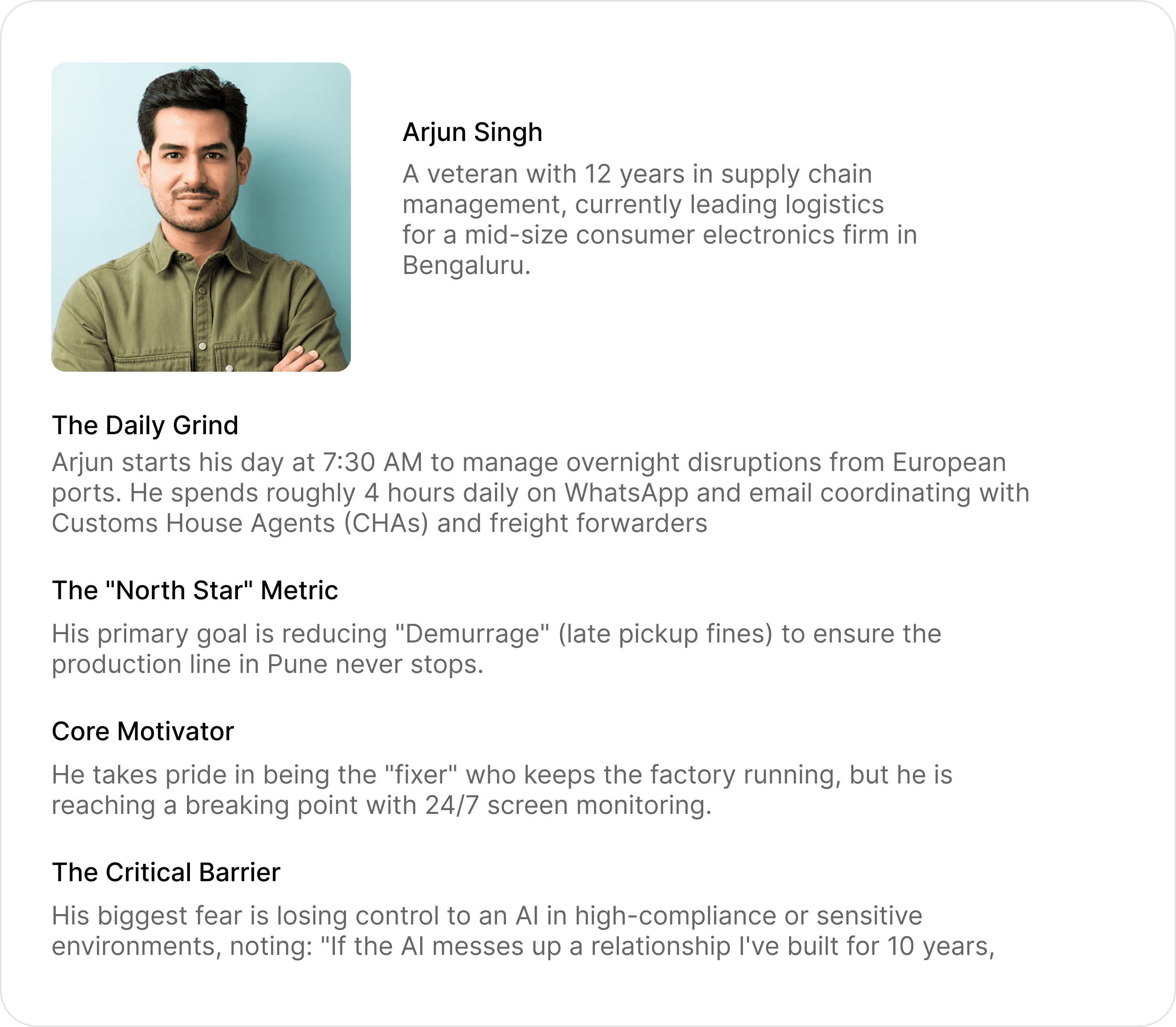
Arjun Singh
A veteran with 12 years in supply chain management, currently leading logistics for a mid size consumer electronics firm in Bengaluru.
The Daily Grind
Arjun starts his day at 7:30 AM to manage overnight disruptions from European ports. He spends roughly 4 hours daily on WhatsApp and email coordinating with Customs House Agents (CHAs) and freight forwarders
The "North Star" Metric
His primary goal is reducing "Demurrage" (late pickup fines) to ensure the production line in Pune never stops.
Core Motivator
He takes pride in being the "fixer" who keeps the factory running, but he is reaching a breaking point with 24/7 screen monitoring.
The Critical Barrier
His biggest fear is losing control to an AI in high compliance or sensitive environments.